

"Buy Our Oil or Build Some Courage" — Trump Tells Europe the Free Ride Is Over
Trump told Europe to protect its own oil. Barbara and Susan spent two hours explaining why that changes everything — from NATO to the Strait to the economy of the future.
Trump told Europe to protect its own oil. Barbara and Susan spent two hours explaining why that changes everything — from NATO to the Strait to the economy of the future.

April 2nd replay now available. Join us LIVE next Thursday.
The Iran war is ending on Trump's schedule, backed by a pre-planned economic and energy strategy that is breaking the transatlantic energy-control system while exposing states and nations that rejected Drill, Baby, Drill.

Hamilton's National Bank was nothing like the Federal Reserve. It funded manufacturing and infrastructure, was audited by Treasury, and couldn't monetize government debt. His system of Sovereign Public Credit built the nation.


“Alexander Hamilton was a British Agent.”
“Alexander Hamilton was a tool of the Rothschilds.”
“Hamilton’s Bank was the first Central Bank in America.”
“The Federal Reserve is the same as Hamilton’s National Bank.”
Many of you have probably heard one or more of the statements listed above. Such are just a few of the STUPID, uninformed opinions that one hears today concerning Hamilton. They are repeated again and again, particularly among certain circles of what are loosely called “libertarians,” but many others have been duped into such opinions by their university professors, Wikipedia or the New York Times.
In reality, present-day slanders against Hamilton all emanate from London. There are several sources for these slanders, but, unquestionably, a primary agent responsible for these lies is an organization named the Mont Pelerin Society. Some very foolish people hold that Society in high esteem, but from the beginning it was, pure and simple, a vehicle to push British imperial economics. The Mont Pelerin Society is not an American institution. It was founded in Switzerland in 1947, and its creation was bankrolled almost entirely by the Bank of England, at the urging of leading aristocrats in Britain, particularly Baron Grantchester of Knightsbridge. Britain’s MI-6 was also heavily involved.
Today, the Mont Pelerin Society is known as the guardian of the “sacred writings” of the mis-named “Austrian School of Economics.” But there is no such thing as the “Austrian School.” Read the works of the “Austrians” Friedrich Hayek and Ludwig von Mises. Who do they praise?—William Gladstone; Lord Acton; Richard Cobden; Adam Smith; James and John Stuart Mill; and similar British aristocrats. All members of the Royal Privy Council or employees of the British East India Company. There are no Austrians here; they are all agents of the British Empire.
In his book The Road to Serfdom, Hayek openly proclaims the pre-1900 era of British laissez faire economics to be the “golden age of mankind.” Hayek has no words of praise for George Washington, nor Abraham Lincoln, nor Henry Carey—and certainly not Alexander Hamilton, an individual he considers a tyrant. His heroes are all British, i.e. British imperialists. Born in Austria, Hayek moved to London and actually gave up his Austrian citizenship to become a British subject. Later, although he moved to America and lived 20 years there, he never applied for U.S. citizenship. His loyalty was always to London. Until his dying breath.
The Mont Pelerin Society is but one of several Anglophile organizations operating today on behalf of the City of London. Others include: the Adam Smith Institute, the Henry Jackson Society, the Atlantic Council, the International Churchill Society, and of course the Royal Institute for International Affairs (Chatham House—which recently sponsored the anti-Trump Mike Pence). All of these associations are dedicated to preserving the “Anglo-American Alliance,” i.e., keeping America subservient to the interests of the City of London. They are all enemies of the Trump Presidency. The Mt. Pelerin Society is merely one component—albeit a very important component—of these British-directed attacks on America. Its British free-trade economics is nothing but a foreign bacillus which has invaded the minds of too many gullible American “conservatives.”
The limited scope of this article does not permit an in-depth discussion of all of the “stupid, uninformed opinions” that slander Alexander Hamilton, but let us look at only one of them: “The Federal Reserve is the same as Hamilton’s National Bank.” Many of you have probably heard this.
Such a view belies woeful ignorance. A Hamiltonian National Bank and an oligarchical Central Bank have nothing in common. As I say in my book National Banking, they are as different as Honey and Vinegar. Statements to the contrary are simply not true. There are many, many technical differences between Hamilton’s Bank of the United States and the present-day Federal Reserve; among them I will mention only five (there are many others):
Those are just a few examples. More examples could be listed, but what has been said is sufficient to make the point. More important—far more important—is the intent of the two institutions. The Federal Reserve operates today to serve the interest of the major Wall Street banks, and working with other Central Banks from around the world to perpetuate the current British financial empire of money. If you read Hamilton’s Report on Manufactures, you find an opposite intention. Hamilton is very, very explicit: to use the credit-generating power of the National Bank to foster science, technology, industry, agriculture and other productive activity; activity which benefits the people of the nation, which builds the nation.
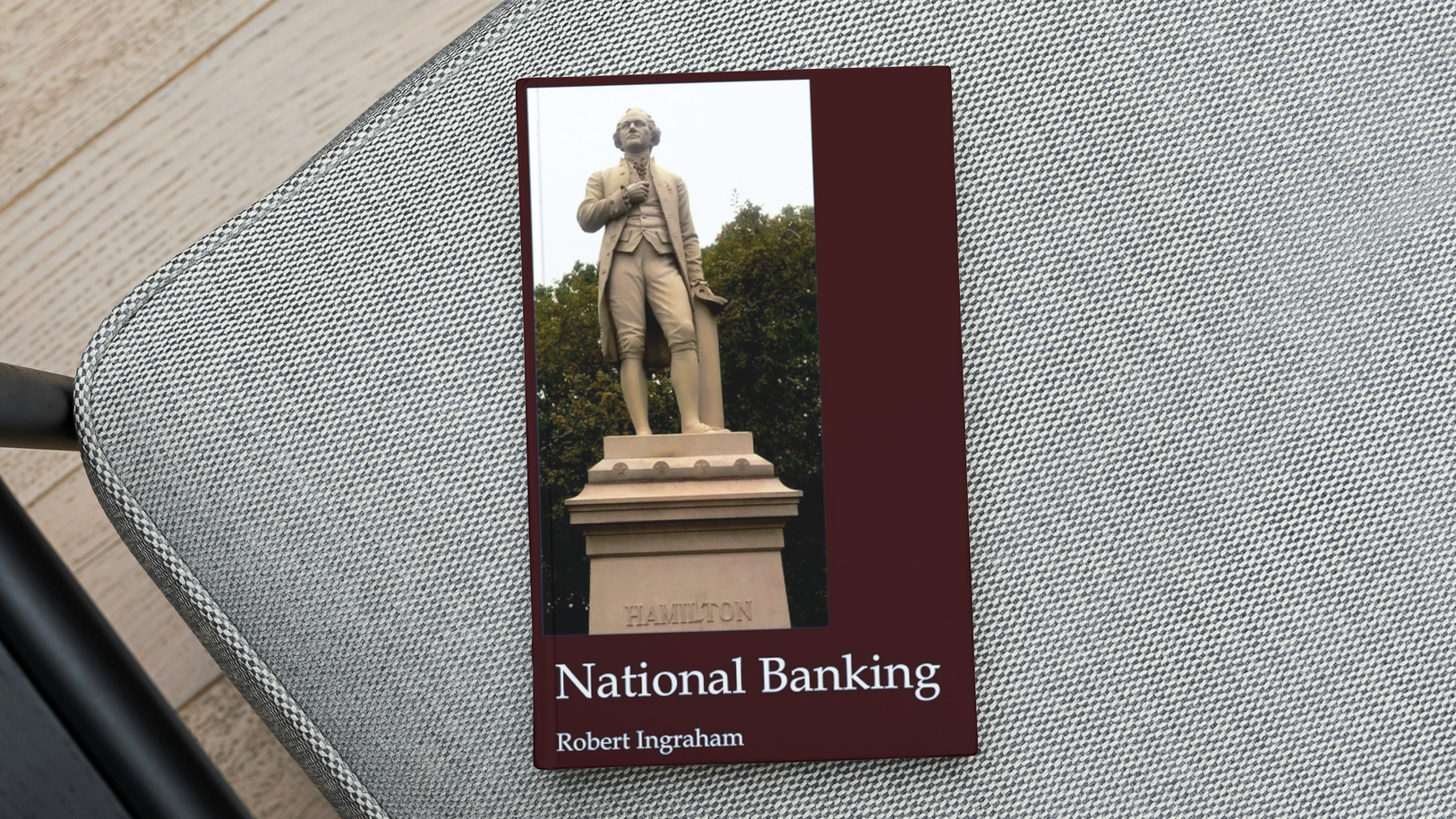
By: Robert Ingraham
Abolish the Federal Reserve. Return to Constitutional banking. This book examines the axiomatic difference between oligarchical Central Banking and legitimate Constitutional monetary, banking and credit methods.
Hamilton created (out of the blue) a new system of Sovereign Public Credit. In one sense this can be seen as a “conveyor belt” of credit flowing from the U.S. Treasury, through the National Bank, into productive investment—manufacturing, agriculture, transportation and infrastructure. Hamilton’s idea was to use the sovereign power of the Constitutional Republic—not the “free market” controlled by London and New York financial speculators—to foster productive economic development on behalf of the General Welfare of all of the People. Hamilton’s writings are also replete with repeated attacks on usury and financial speculation. The goal was Credit for productive development, not the amassing of monetary wealth.
People should stop listening to the slanders against Hamilton. He was George Washington’s loyal partner in developing the nation. More important is the urgent requirement today that our current banking and financial system must be reorganized to embrace the principles enunciated by Hamilton in order to fulfill Donald Trump’s mandate to “Build, Baby, Build.”
In conjunction with his establishment of a National Bank, Hamilton authored his Report on Manufactures. There is no way to fully grasp the intention, the purpose, of the National Bank without studying this Report. For those who blindly slander Alexander Hamilton, but have not read his Report on Manufactures, my admonition is that you are simply not qualified to contribute anything useful to this discussion. First, you must carefully study Hamilton’s Report. It might open your eyes. For other readers—those with an open and un-biased mind, read on.
In appointing Hamilton as Treasury Secretary, George Washington described him as a man of “probity and Sterling virtue,” and he placed in his hands the responsibility to rescue the nation from bankruptcy and economic disintegration. In 1791 the total debt of the federal and state governments was $77.1 million, a staggering amount for a small bankrupt nation. Hamilton's strategy was simple: consolidate all of the debt into one pile, fund the federal debt at par, and assume all the state debts. Tariffs and excise taxes would be implemented to fund the debt, and a National Bank established to manage all investments and payments at the federal level.
This plan worked beautifully, and between 1791 and 1801 U.S. sovereign debt was reduced (paid-off) dramatically. At the same time, as the debt was now secure, it was placed on deposit in the National Bank—as an asset guaranteed by the Federal Government—where it became the backing for the issuance of new loans into manufacturing and other productive investments. Hamilton’s plan was to reduce the debt, but at the same time use the existing debt as “collateral” for economic development. It worked. [Note, however, that the debt began to rise again in 1801, during Jefferson’s first year as President, reaching a total of $130 million by the end of his second term.]
Let us consider a little more Hamilton’s Report on Manufactures. In that work he delineates a plan of Protective Tariffs, Bounties and Premiums, all designed to spark scientific and industrial growth. At the insistence of both Washington and Hamilton, the nation’s first protective tariff was adopted. Then in 1790, a more aggressive tariff, authored personally by Hamilton, was adopted, raising the tariff rate from 5 percent to between 7 and 10 percent. The additional twin initiatives of Bounties and Premiums involved using a small portion of the tariff revenue to fund the work of scientists and inventors involved in technological breakthroughs. Hamilton also proposed that the National Government use two percent of the national debt to finance the creation of a “National Manufactory,” which would serve as a laboratory and testing facility for advancements in industry and technology.
In 1791 Hamilton helped found the Society for Establishing Useful Manufactures, which established an in-depth industrial complex in Paterson, New Jersey. This was, in a sense, a pilot project for public-private partnerships in developing the nation. Despite a rocky start and some poor local leadership, the Patterson works became for a time the largest manufacturing center in America and continued in operation for 150 years, beginning with cotton processing for textiles and clothes and later becoming a leading center of iron production.
Other initiatives by Hamilton have already been discussed in this author’s previous article on George Washington, including the construction of Lighthouses along the eastern seaboard and the 1790 creation of the U.S. Merchant Marine and Coast Guard, both at Hamilton’s urging. As a result of both the tariffs and the creation of the Merchant Marine, during the eight years of the Washington Presidency, the registered tonnage of American ships engaged in foreign trade increased by 384 percent. Ship-building boomed, spurred on by the credit policies of the National Bank.
A key concept that must be grasped in understanding all of this is “Sovereignty.” Under Hamilton, American economic and monetary policy would not be controlled by “private” financial oligarchs, be they in London, Paris or New York City. The Constitutional commitment to develop the nation for the benefit of the people would be paramount. As per the Constitution, the U.S. Government would coin (or print) its own sovereign currency, determine how that currency would be put into circulation, and identify the priorities for investment as to the building up of the nation. Actual societal wealth would flow precisely from this commitment.
We don't run ads on our website. We don't take corporate sponsors.
Our work is funded almost entirely by readers and viewers like you. For just $10 a month, you directly support the writers and editors bringing you the truth about what's really happening in our fight to rebuild the nation.
Become a paid subscriber and join us in this battle.

Will Wertz traces the millennia-long battle between national sovereignty and empire — from Plato to Nicholas of Cusa to the EU — and shows why a new Bretton Woods system is the path forward.


They rewrote your history. A suppressed 400-page manuscript — hidden for 230 years — reveals the true philosophical war behind the American Revolution. Charles Park traces the direct line from Leibniz through Logan and Franklin to the founding of the republic.

The globalists didn't just attack our economy and sovereignty — they waged a centuries-long war on our culture. Toni Sellars and Mindy Pechenuk trace the battle for classical music from Brahms to the boardrooms of Wall Street.


President Trump re-established the 1776 Advisory Committee to restore true American history. This paper reveals a lost 400-page manuscript proving America's founders drew their ideas from Leibniz, not Locke — fighting for intellectual independence decades before 1776.
Get our free newsletter. Zero Spam.