

"Buy Our Oil or Build Some Courage" — Trump Tells Europe the Free Ride Is Over
Trump told Europe to protect its own oil. Barbara and Susan spent two hours explaining why that changes everything — from NATO to the Strait to the economy of the future.
Trump told Europe to protect its own oil. Barbara and Susan spent two hours explaining why that changes everything — from NATO to the Strait to the economy of the future.

April 2nd replay now available. Join us LIVE next Thursday.
The Iran war is ending on Trump's schedule, backed by a pre-planned economic and energy strategy that is breaking the transatlantic energy-control system while exposing states and nations that rejected Drill, Baby, Drill.

The untold story: How Washington's determination to build a canal led directly to the U.S. Constitution.


In the summer of 1787 representatives from 12 of the 13 U.S. states gathered in Philadelphia, at a time of great crisis, to address the reality that the Articles of Confederation had failed and the country was sinking into chaos and economic collapse. The end result of those deliberations was, of course, the signing of a new Constitution for the American Republic.
How many Americans today are aware that the prime instigator of that initiative was George Washington, and that to a significant degree Washington’s motivation flowed from his efforts to develop the new nation economically, specifically through the creation of a great water project? That a canal project was the spark for what became the United States Constitution?
Only 12 months after the signing of the Treaty of Paris, ending the Revolutionary War, in September 1784 George Washington conducted a personal tour of the Ohio territory and lands west of the Allegheny Mountains. Traveling through wilderness, the trip covered 680 miles. One of the primary goals of the inspection was to determine the best route for building a canal connecting the Potomac and James rivers with western waterways.
The Potomac River was the shortest potential route between the Virginia tidewater and the headwaters of the Ohio River, with access to the western frontier. This project was at the forefront of Washington’s determination to open the west for settlement and develop the productive power of the young American economy.
Three months after his western journey, Washington organized a meeting, at Alexandria, where he and other Virginia commissioners met with their counterparts from Maryland, to discuss his proposed water project. Unfortunately, the Alexandria conference broke down due to rivalries between the Virginia and Maryland delegates. Under the Articles of Confederation, the national government was prohibited from building major infrastructure projects, and as Washington discovered trying to get agreement among individual “sovereign” states for such a project was near impossible.
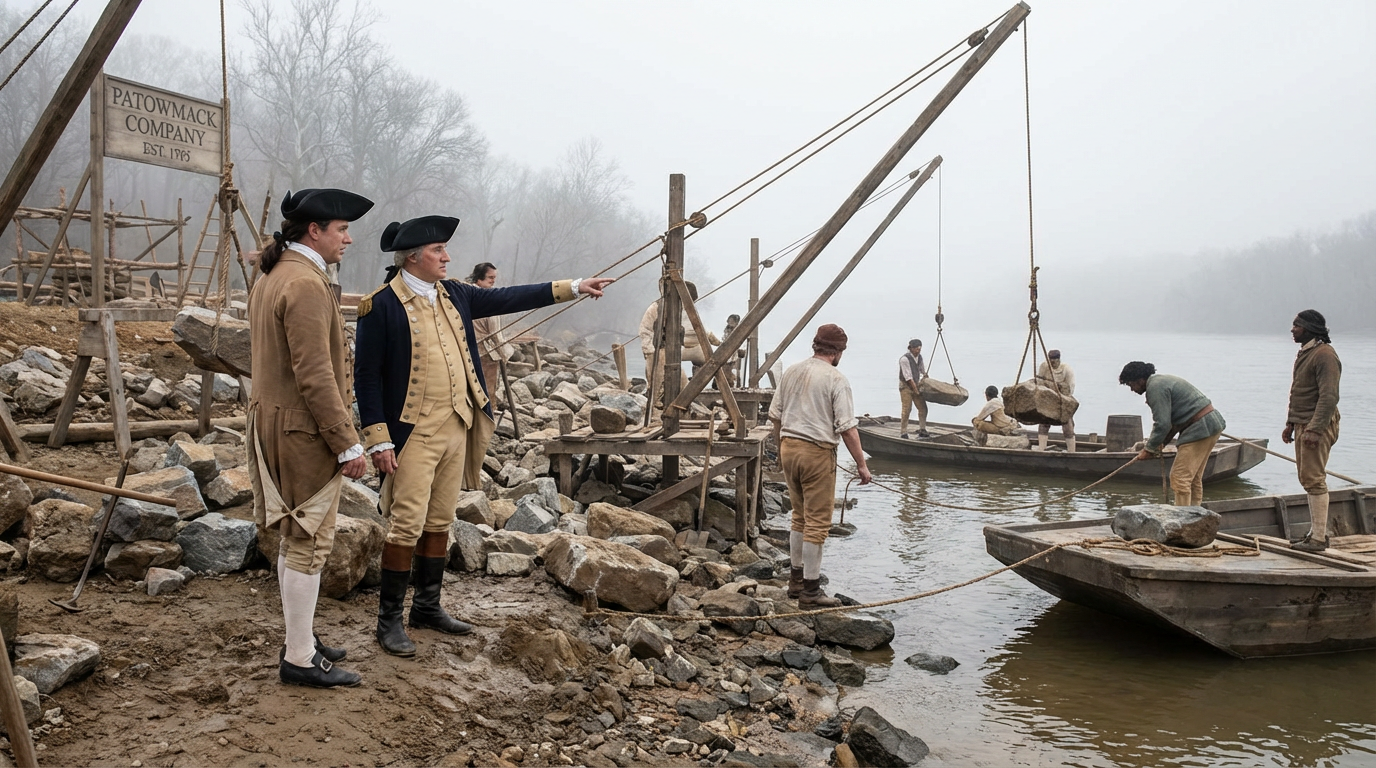
Undeterred, Washington organized a second conference, this at his home at Mt. Vernon, from March 21 to March 28, 1785. Washington chaired the conference, and under his direction the delegates from Virginia and Maryland agreed to establish a joint company—the Patowmack Company—to improve the Potomac River between its headwaters and the tidewater at Georgetown. They also agreed to establish uniform tariffs, joint operation of lighthouses and several other economic initiatives.
The Mt. Vernon delegates formed a new “Patowmack Company,” Washington was elected the president, and by early 1785 the company began work, hauling rocks out of the upper river to create a shipping channel.
All of this was illegal! Under the Articles of Confederation, individual states were strictly forbidden to form treaties or agreements among themselves for such projects. Washington dismissed these restrictions, describing the Articles of Confederation as “a half-starved, limping Government that appears to be always moving upon crutches, and tottering at every step.”
The creation of the Patowmack Company was not Washington’s end goal. At Mt. Vernon several delegates proposed inviting Pennsylvania and Delaware to join the canal project. Instead, Washington proposed a conference which would include all of the 13 states, and he persuaded the Virginia legislature to send out an invitation to all of the states to attend a general convention at Annapolis in September 1786. This was the beginning of the chain-of-events that led to the Philadelphia Convention in 1787.
Washington initiated and led this fight, and the Mount Vernon Conference has rightly been named as the true birthplace—some have called it the “Cradle”—of the United States Constitution.
During the Spring and Summer of 1786, Washington wrote numerous letters to leading individuals—notably an intense dialogue with Alexander Hamilton— urging support for the upcoming Annapolis Conference. In one letter—this to John Jay—he explained the the necessity of replacing the Articles of Confederation:
“Your sentiments, that our affairs are drawing rapidly to a crisis, accord with my own. What the event will be, is also beyond the reach of my foresight. . . . I do not conceive we can exist long as a nation, without lodging somewhere a power which will pervade the whole Union in as energetic a manner as the authority of the State governments extends over the several States. To be fearful of investing Congress, constituted as that body is with ample authorities for national purposes, appears to me the very climax of popular absurdity and madness. . . What then is to be done? Things cannot go on in the same train forever. It is much to be feared, as you observe, that the better kind of people, being disgusted with these circumstances, will have their minds prepared for any revolution whatever. We are apt to run from one extreme into another. To anticipate and prevent disastrous contingencies would be the part of wisdom and patriotism.”
Despite Washington’s efforts, delegates from only five states attended the Annapolis Convention. At this point Alexander Hamilton authored the Annapolis Resolution, sent both to the national Congress as well as to all of the state governors, calling for the convening of a national convention. It is very clear that during all of this it was Hamilton, not James Madison, who functioned as Washington’s most trusted lieutenant in pushing this project forward.
Washington’s leadership in the fight to create a unified sovereign Republic actually precedes these events. At the conclusion of the Revolutionary War, in June 1783, he authored a Circular Letter to the States, sent to all 13 state governors and reprinted in newspapers throughout the nation. In part it read:
“This is the favorable moment to give such a tone to the federal government, as will enable it to answer the ends of its institution; or, this may be the ill-fated moment for relaxing the powers of the union, annihilating the cement of the confederation, and exposing us to become the sport of European politics, which may play one State against another, to prevent their growing importance, and to serve their own interested purposes. For, according to the system of policy the States shall adopt at this moment, they will stand or fall; and, by their confirmation or lapse, it is yet to be decided, whether the Revolution must ultimately be considered as a blessing or a curse:—a blessing or a curse, not to the present age alone, for with our fate will the destiny of unborn millions be involved.”
When the delegates assembled in Philadelphia in May 1787, Washington was elected unanimously as the President of the Convention. Despite falsified stories to the contrary, Washington did not just “preside” over the Convention, his role was decisive. He stayed at the home of Robert Morris, leader of the Bank of North America; his co-lodger was Gouverneur Morris who would author the Preamble to the Constitution. His chief lieutenant on the floor of the Convention was, again, Alexander Hamilton. As the endless bickering at the Convention went on week after week, Washington became extremely frustrated, and in a July 10 letter he sent to Hamilton (then in New York), he wrote that:
The situation at the Convention is, “if possible, in a worse train than ever; you will find but little ground on which the hope of a good establishment can be formed,” and “I am almost despaired of seeing a favorable issue to the proceedings of the Convention," and he attacked the “men who oppose a strong and energetic government,” calling them “narrow minded politicians who are under the influence of local views.”
One example of Washington’s resolve occurred on June 18, when he turned over the agenda to Alexander Hamilton, who delivered a 6-hour impassioned speech on the need to create a strong sovereign national government capable of carrying out urgent economic development. Hamilton and Washington had held a lengthy private discussion the day before the speech, and it is clear, as it was clear at the time to the other delegates, that on June 18 Hamilton spoke as much for Washington as for himself.
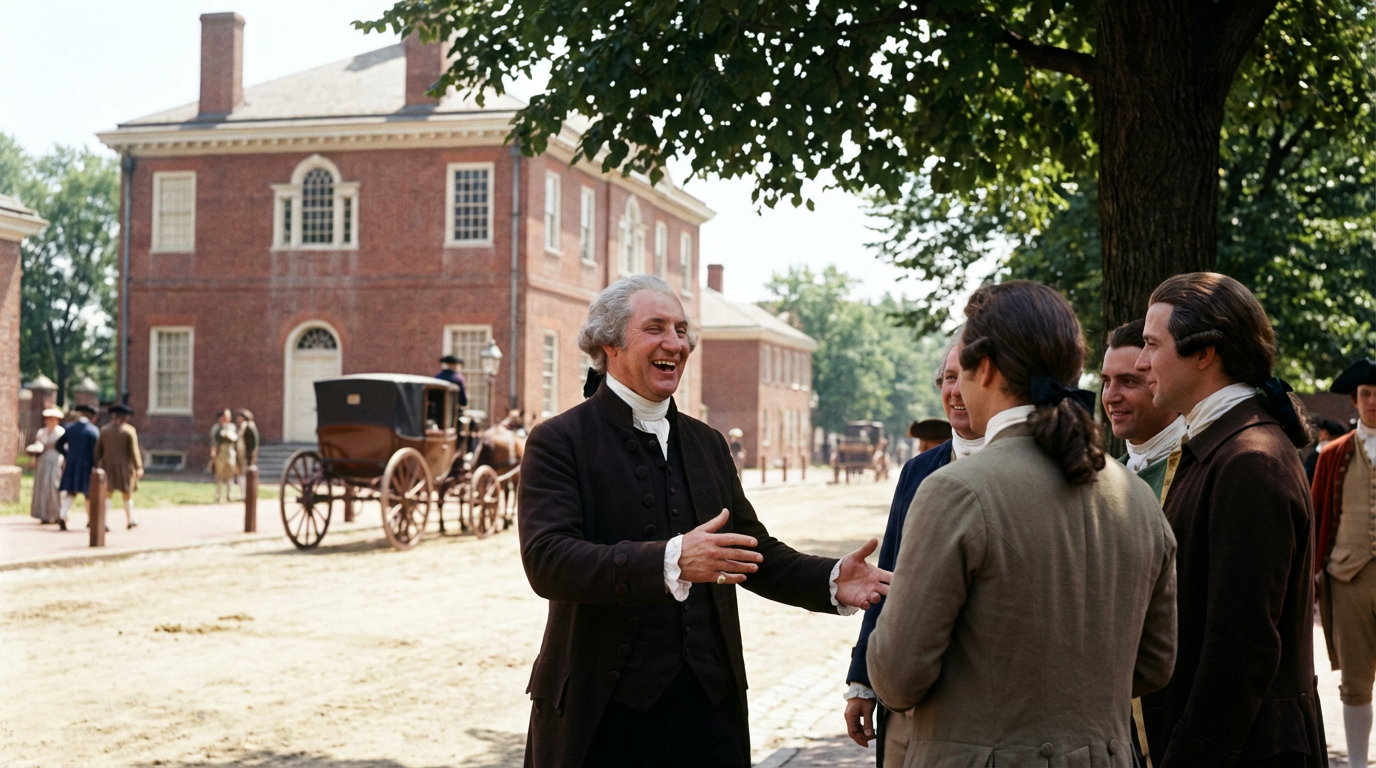
In the end, Gouverneur Morris’ Preamble, committing the Republic to defend the General Welfare” of ALL OF THE PEOPLE carried the day, and the final Constitution contained powerful clauses empowering the government to pursue economic, scientific and technological progress.
The story of Washington’s support for Alexander Hamilton’s 1789-1793 initiatives to create a National Credit System for nation-wide economic development will be covered in the next installment of this series. Here we look at just a sampling that indicates his intention in that direction.
During his first year in the Presidency, Washington succeeded in creating the United States Lighthouse Establishment as an agency under the control of the Department of the Treasury. All private and state U.S. lighthouse ownerships were transferred to the national government, and funding was secured to begin construction of new lighthouses at critical coastal sites. The first of these was the 1792 Cape Henry Lighthouse. This was the first national public works project in American history. Note that there is no “enumerated power” in the Constitution authorizing the Government to do this; it was carried out through the power of sovereign government on behalf of the General Welfare.
Other actions taken by Washington include: Washington’s signing of the Copyright Act of 1790, protecting individual inventors and encouraging their work, and the 1790 creation of the U.S. Merchant Marine and Coast Guard. These organizations maintained the lighthouses, protected the coastline and enforced tariff laws; and the Tariff Law of 1789 that established tonnage rates favorable to American carriers by charging them lower cargo fees than those imposed on foreign ships. Coastal trade was reserved exclusively for American flag vessels.
All of this was designed to promote rapid expansion of manufacturing, agriculture and other productive activity. During the Washington Presidency, the registered tonnage of American ships engaged in foreign trade increased by 384 percent. In 1790, a new tariff, written by Hamilton, was adopted. This increased the average rate of tariff from 5 percent to between 7 and 10 percent, and added other items to the list subject to tariffs.
In his private life, Washington became a pioneer in the development of modern science-driven agriculture. As early as 1760, Washington began to shift almost all of the agricultural production at Mt. Vernon out of tobacco and into grains, including wheat, oats, rye and barley. Over the next 20 years he studied and mastered the most advanced ideas in agricultural science, and in a manner not dissimilar to Benjamin Franklin, he conducted hundreds of experiments in a wide array of new farming methods such as crop rotation, the use of different fertilizers, developing new plant hybrids and new breeds of livestock.
He also transformed Mt. Vernon into the nation’s first agro-industrial complex, introducing new equipment, new inventions and new methods of production, including semi-automation of various tasks such as milling and threshing. Washington became the recognized leader for agricultural change in America.
By the time of the Revolutionary War, Washington was the leading wheat farmer in America. His wheat and flour were sold under his own label—stamped “G. Washington”—and shipped to all thirteen colonies. “Washington's Wheat” became famous, and he became the first exporter of wheat in the United States.
Washington also expanded into fisheries, dairy farming, textiles and other areas. His fishery processed over 1 million fish per year. What Washington built at Mount Vernon was an “agro-industrial village,” the likes of which existed nowhere else in America.
When the Patowmack Company began construction of the Potomac Canal, Washington hired as the Chief Engineer a man named James Rumsey. But Rumsey was not just an engineer, he was an inventor, and simultaneous with his canal-building responsibilities he was engaged in developing what would become the first steam-powered boat in America. Rumsey showed Washington a working model of his boat, and Washington enthusiastically agreed to help him. To secure investors, Washington gave Rumsey a certificate as follows:
“I have seen the model of Mr. Rumsey's boat, constructed to work against the stream, examined the powers upon which it acts, been the eye witness to an actual experiment in running water of some rapidity and give it as my opinion, although I had but little faith before, that he has discovered the art of working boats by mechanism and small manual assistance against rapid currents: that the discovery is of vast importance: may be of the greatest usefulness in our inland navigation, and if it succeeds, of which I have no doubt, that the value of it is greatly enhanced by the simplicity of the works; which when seen and explained, may be executed by the most common mechanic.”
Washington, together with Benjamin Franklin, also became backers of another pioneer in steam-powered boats, a man named John Fitch, who initiated the first commercial steamboat service in America. Fitch later built a “prototype of a practical land-operating steam engine,” meant to operate on tracks—in other words, a steam locomotive.
A third inventor protégé of Washington’s was Col. John Stevens. In 1776, at age 27, Stevens was appointed a captain in Washington's army in the Revolutionary War, and he developed a personal relationship with Washington. After the War, Washington supported and encouraged Stevens in his scientific work. Much later, in 1806, Stevens built the first steamship to navigate the open ocean, and in 1812 he issued a pamphlet—Documents Tending to Prove the Superior Advantages of Rail-ways and Steam Carriages over Canal Navigation—arguing for railroads. Note that in 1812 there were no steam-powered locomotives in existence. Three years later, Stevens built a circular railroad track on his property in Hoboken, and began operating a full-size steam-powered engine.
Scientific Progress, manufacturing, modern agriculture, the development of the nation,—these were all things that Washington sought to secure through the creation of a sovereign Republic. A Nation built on upward progress.
We don't run ads on our website. We don't take corporate sponsors.
Our work is funded almost entirely by readers and viewers like you. For just $10 a month, you directly support the writers and editors bringing you the truth about what's really happening in our fight to rebuild the nation.
Become a paid subscriber and join us in this battle.

Will Wertz traces the millennia-long battle between national sovereignty and empire — from Plato to Nicholas of Cusa to the EU — and shows why a new Bretton Woods system is the path forward.


They rewrote your history. A suppressed 400-page manuscript — hidden for 230 years — reveals the true philosophical war behind the American Revolution. Charles Park traces the direct line from Leibniz through Logan and Franklin to the founding of the republic.

The globalists didn't just attack our economy and sovereignty — they waged a centuries-long war on our culture. Toni Sellars and Mindy Pechenuk trace the battle for classical music from Brahms to the boardrooms of Wall Street.


President Trump re-established the 1776 Advisory Committee to restore true American history. This paper reveals a lost 400-page manuscript proving America's founders drew their ideas from Leibniz, not Locke — fighting for intellectual independence decades before 1776.
Get our free newsletter. Zero Spam.