Are we fighting the wrong war? Mike Steger examines Trump, Washington, Hamilton, and why leadership, national purpose, and the American System matter heading into the 2026 midterms.
Trump cut a diesel deal with Putin and told Zelensky to stop hitting refineries. Zelensky went to thank King Charles instead. The same week, Bessent told the IMF America is done playing by globalist rules.
Replay now available. Join us LIVE next Tursday! Days after Trump said Ukraine needs a new president, Zelensky ran home to London. Barbara and Susan expose Europe's drive for war and censorship, LIVE today at 11am Eastern.
Saturday Class - The America You Don't Yet Know - March 14, 2026
They rewrote your history. A suppressed 400-page manuscript — hidden for 230 years — reveals the true philosophical war behind the American Revolution. Charles Park traces the direct line from Leibniz through Logan and Franklin to the founding of the republic.
What if the real story behind the American Revolution has been hidden from you for over 200 years?
That's not a rhetorical question. A 400-page manuscript — written decades before the Declaration of Independence — was suppressed for over 230 years.
It proves that the intellectual foundations of our republic were far deeper, and far more radical, than anything you were taught in school.
In this week's class, Charles Park — who worked alongside Lyndon LaRouche for 50 years on the intellectual battles that shaped America — presents the suppressed philosophical history behind our founding. His starting point: President Trump's January 2025 executive order reestablishing the 1776 Advisory Committee to restore America's true history for the 250th anniversary.
President Trump's January 2025 executive order reestablishing the 1776 Advisory Committee
The class centers on three universal geniuses —
Gottfried Leibniz,
James Logan,
and Benjamin Franklin
— and the irreconcilable philosophical war they waged against the apologists of the British Empire: Thomas Hobbes, John Locke, and Isaac Newton.
Two world outlooks, locked in battle
On one side: the Hobbesian view — that man is an unreasoning beast, driven only by self-interest, requiring an authoritarian "social contract" to prevent chaos. This became the philosophical justification for the British Empire and remains the foundation of the globalist world order today.
On the other: the Renaissance concept of Imago Viva Dei — that every human being is made in the image of the Creator, endowed with a creative mind capable of discovering new principles of the universe. This is the tradition that informed our founding fathers and gave us "life, liberty, and the pursuit of happiness" — Leibniz's concept, which Franklin ensured was placed into the Declaration of Independence over Locke's "life, liberty, and property."
The lost manuscript
The primary source for this class is a 400-page manuscript written by James Logan between 1732 and 1737, titled Of the Duties of Man, As They May Be Deduced from Nature. Logan — secretary to William Penn, mayor of Philadelphia, chief justice, and acting governor of Pennsylvania — was the philosophical mentor who helped inspire and educate the young Ben Franklin.
His manuscript is a systematic, reasoned refutation of Hobbes, Locke, and Newton. It demonstrates that an intellectual independence from the British Empire — steeped in Renaissance ideas and rooted in Leibniz — existed within the developing American intelligentsia decades, even a century, before the formal Declaration of Independence.
The manuscript was considered lost for 200 years until a copy was discovered in the 1970s, buried under cartons in the Historical Society of Pennsylvania. After a limited publication, it disappeared from circulation again. Out of 250 years of American history, this foundational document has been available for roughly 20. Much of this material is documented at length in Phil Valenti's original study of Logan and the other intellectuals surrounding Benjamin Franklin.
From Leibniz to Franklin to Hamilton
Charles traces the direct intellectual pipeline from Leibniz through Logan and Franklin to the American System of Economics. Logan publicly defended Leibniz in the calculus dispute with Newton. He recognized, a decade before Franklin's famous electricity experiments, the potential of electricity to overturn Newtonian physics. And when Logan died in the 1750s, he willed his 3,000-volume library — one of the largest in America — to become the first lending library, the Philadelphia Library Company, founded by Franklin.
The connection extended across the Atlantic. By the 1740s, Franklin was in direct correspondence with Abraham Kästner and other scholars at the Leibnizian Göttingen University in Germany — established by Princess Caroline, a protégé of Leibniz, specifically to preserve and transmit his ideas after King George seized Leibniz's writings. By 1765, Leibniz's New Essays on Human Understanding — his rebuttal of Locke — was in the Philadelphia Library Company with a preface by Kästner.
"When Americans realize that they're tasked with the joyful responsibility to restore, protect, and advance the Renaissance ideas that made our nation unique in world history, the true American spirit will be rekindled on a scale that leaves the British Wall Street globalists in history's dustbin. Let us finish the American Revolution — in such a way as to be the beacon of hope for the rest of the world."
This is the first of two classes. The follow-up will explore the culture that shaped the American fight for independence.
Watch the class and discover the America you don't yet know.
Activist with LaRouche since the 1970s. Author and speaker on the culture of the American Revolution, Ben Franklin, and James Logan. Follow my Substack, “Creating a New American Intelligentsia.”
Founding member of the LaRouche movement in the 1960s. Former editor of LaRouche’s writings and EIR magazine. Regular host of our Saturday class series.
America went from candles and the horse and buggy to telephones, cars and airplanes, in one lifetime. Bob Ingraham shows how tariffs and Hamiltonian credit did it, and why the same tools, back in play today, can do it again.
Why “super” and not “artificial”? Brian Lantz shows SI at work in an Arizona copper mine, aimed at a nuclear-powered Moon, and in service of new forms of human creativity. Watch the full class.
Two conductors. One score. Two opposite ideas of man. This week's Class puts Furtwängler against Toscanini — and tonal against atonal. The fight over your ear is the fight for your children's future.
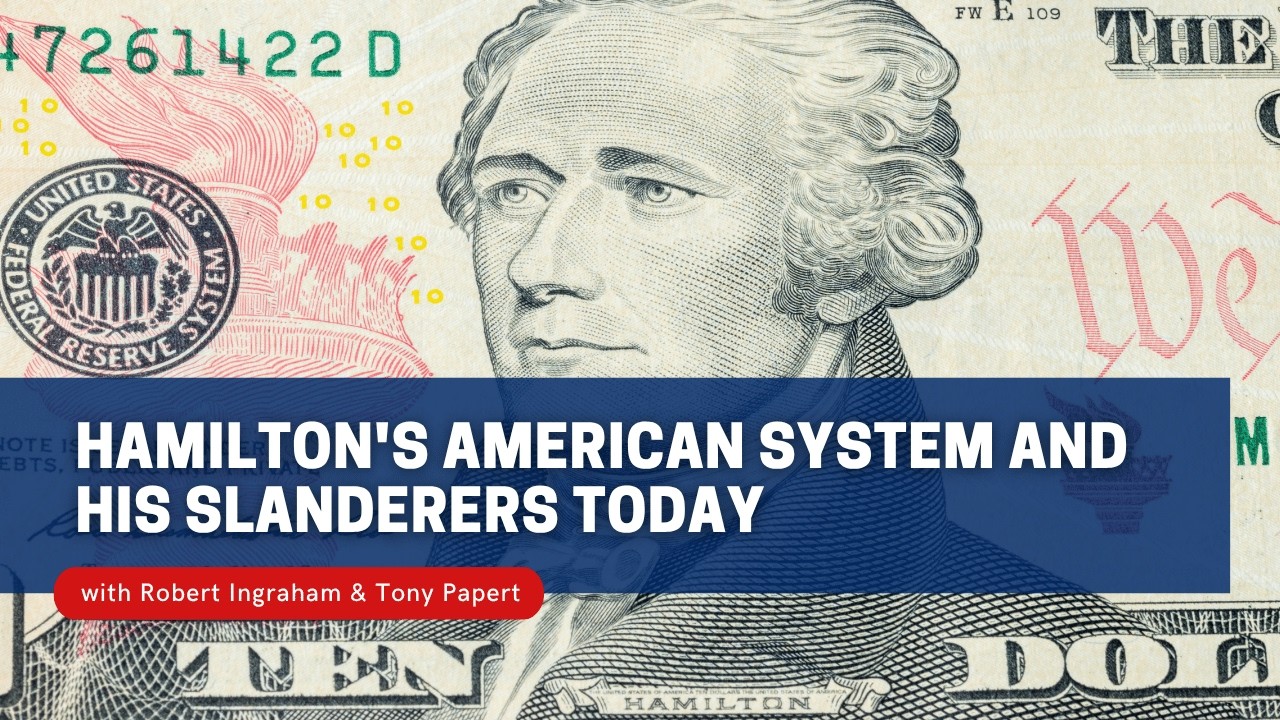
Bob takes on the slanders against Alexander Hamilton and the British-finance axioms most Americans still carry — and why Hamilton's bank is not the Fed.