Bob Ingraham shows how Hamilton turned Revolutionary War debt into public credit — and why Bessent's growth fight with the IMF is the same war over who decides America's economic destiny.
Chatham House frets Trump will be “unshackled” after the midterms. Rubio says America is no longer defensive. Susan Kokinda on diesel, Yalta panic, and the executive tools that don’t need Congress.
A new Washington Post report raises questions ahead of the 2026 midterms. Mike Steger examines the officials, political networks, and election preparations behind the headlines.
Saturday Class - Artemis II and the Divine - April 18, 2026
Victor Glover's Easter message from lunar orbit has a 600-year lineage. Bob Ingraham traces the unity of Christian faith and scientific breakthrough from Dufay and Josquin to Brunelleschi, van der Weyden, and the carracks that opened the New World.
The Artemis II astronauts didn’t just break a half-century record — they reopened the question every genuine renaissance has answered: what is a human being?
As the Orion spacecraft prepared to lose radio contact on the far side of the Moon, pilot Victor Glover sent what has since been called his Easter message back to Earth:
“As we continue to unlock the mysteries of the cosmos, I would like to remind you of one of the most important mysteries on Earth. And that’s love… To all of you down there on Earth and around Earth, we love you from the Moon.”
In this week’s Saturday Class, Bob Ingraham takes that transmission and traces it to its source — a 600-year tradition that unified Christian faith with scientific breakthrough and built the civilization we still live inside.
No conflict between faith and science
Victor Glover is both a devout Christian and an accomplished scientist. In an interview before the mission, he put it plainly:
“The Christian faith and science don’t actually work against each other, like some people like to claim. I had to navigate that because of my faith and my belief in science. I believe in both, and I don’t find them to be in conflict.”
This is no throwaway line. The claim that faith and science are enemies is one of the oligarchy’s most successful frauds. The Renaissance of the 14th and 15th centuries was built on the opposite premise — and so is every durable advance in human civilization since.
The Renaissance got this right
Most people picture the Renaissance as paintings and cathedrals — Michelangelo’s Sistine Chapel, Leonardo’s Last Supper. They come back from Florence impressed, but without a grip on what actually happened there.
What happened was a revival of Christian faith grounded in a specific truth: that every human being is made in the image of God, and that through creativity and reason, we are called to improve the condition of life for those still to come. That conviction, operating across fields, produced the greatest concentration of scientific, artistic, and technological breakthroughs in European history.
Featured: Bob Ingraham’s new book
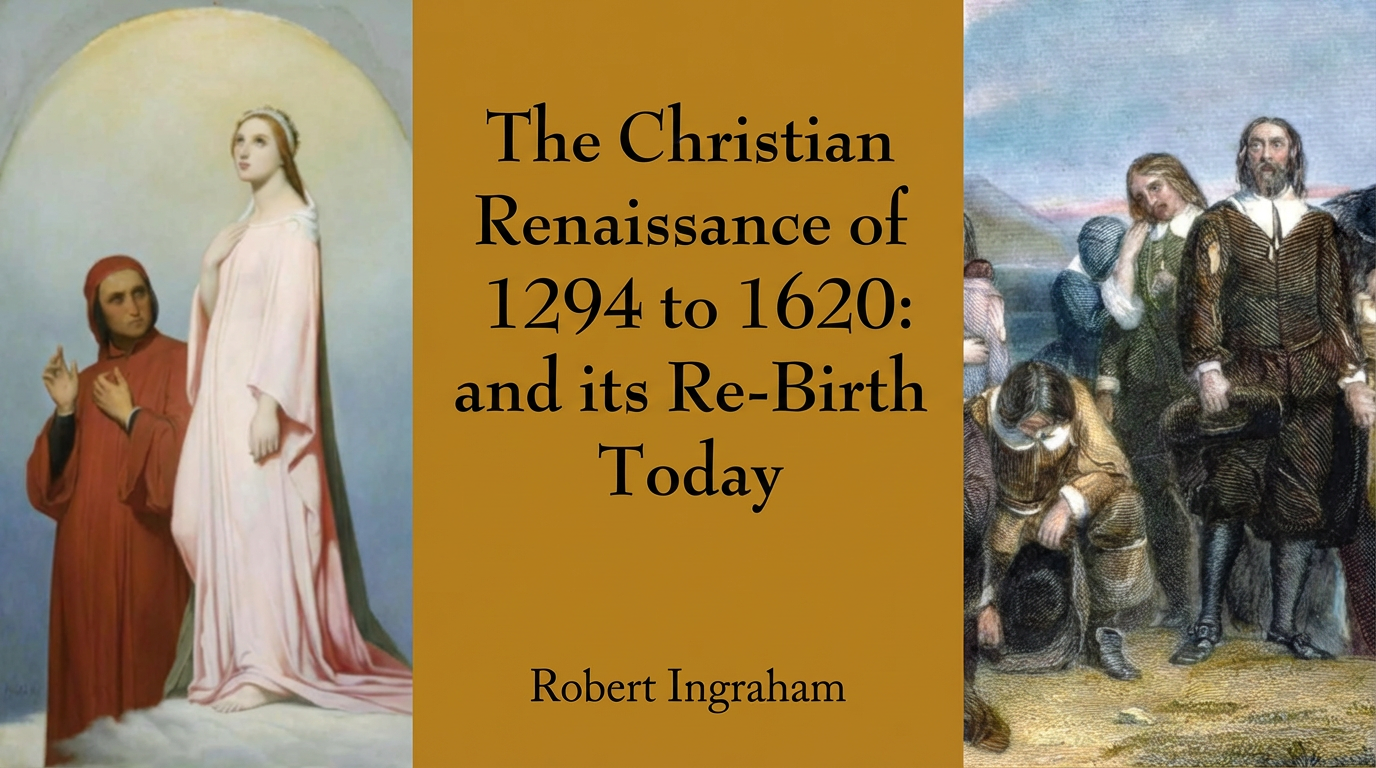
Bob has just published his own deep treatment of this subject — The Christian Renaissance of 1294 to 1620 and Its Rebirth Today. The book takes its dates from Dante’s La Vita Nuova (1294) and the signing of the Mayflower Compact at Plymouth (1620), and traces the Christian thread that runs through both. It is available on Amazon in paperback (color and black-and-white), Kindle, and audiobook.
Bob walks through two of the great Renaissance composers — Guillaume Dufay and Josquin des Prez. Both wrote profoundly devotional music. Both also produced the most advanced compositional breakthroughs anyone had attempted: polyphony, counterpoint, the interplay of voices, the calculated use of intervals.
Dufay composed Nuper Rosarum Flores in 1436 for the consecration of the Florence Cathedral — the celebration of Brunelleschi’s dome, the greatest architectural achievement of the Renaissance. The most advanced science of its day, set in music, sung at the dedication of the most advanced engineering of its day.
Josquin’s Ave Maria … Virgo Serena (1476) is still considered one of the greatest compositions ever written. His In Te Domine Speravi, composed for Isabella d’Este of Ferrara, pioneers the interplay of voice and instrumental quartet.
These were not decorative exercises. They were scientific breakthroughs in composition, written to draw the worshipper into a deeper and more profound form of devotion to God.
Paintings that make you a participant
The revolution in Renaissance art was not technique for its own sake. It was a method for drawing the viewer in — making you a participant in a religious drama rather than a spectator in front of a Byzantine icon.
Bob points to three works:
Giotto, The Lamentation (Scrovegni Chapel, Padua) — Giotto broke with Gothic and Byzantine art, introducing perspective and human expression. You see sorrow on the faces. You are no longer looking at an icon; you are pulled into the scene.
Masaccio, The Tribute Money — a student and collaborator of Brunelleschi, Masaccio deployed the new science of perspective to portray the dialogue between Christ and the apostles with a realism that had never existed anywhere on Earth.
Rogier van der Weyden, The Descent from the Cross (1435) — Nicholas of Cusa called van der Weyden “the most noble of all painters.” The tears streaming down Mary Magdalene’s face, the collapsed grief of Mary, the wounds of Christ — these are not decoration. They are a breakthrough in the ability of art to move a human soul.
Brunelleschi and the science of perspective
Brunelleschi didn’t just recover Roman knowledge — he surpassed it. Working with Masaccio the painter and Donatello the sculptor, he conducted dozens of perspective experiments. In one famous demonstration, he held up a painting of the Florence Baptistery together with a mirror, so that a viewer could see both the painted Baptistery and the actual building through a peephole — and judge how precisely the painted geometry matched reality.
From those experiments came the precision perspective of Piero della Francesca, and eventually Leonardo. From those same experiments came the dome of the Florence Cathedral, built using techniques no one else could duplicate.
The caravel, the carrack, and the age of discovery
The Age of Discovery was not separate from the artistic and musical revolution — it was the same Renaissance, operating at sea.
Under Henry the Navigator of Portugal (1394–1460), European ships began leaving sight of the coast for the first time. The breakthrough was a new vessel — the caravel — with lateen sails and a modern rudder, allowing ships to tack into the wind. It was fast, and it could sail where previous ships could not.
The caravel’s successor, the carrack, was the Saturn V rocket of the 15th century. Columbus’s Santa Maria was a carrack. Magellan crossed the globe in a carrack. Vasco da Gama opened the sea route to India in carracks. And Giovanni da Verrazzano sailed a carrack — La Dauphine — up the full eastern coast of North America in 1524, the first European to enter what is now New York Harbor.
These were not random voyages. They were a direct product of the same scientific and spiritual awakening that produced Dufay’s music and van der Weyden’s painting — and they were sponsored, in Verrazzano’s case, by the same King Francis I who rescued Leonardo da Vinci from house arrest in Rome and brought him to Paris.
A renaissance is a reawakening
Dante invented the modern Italian vernacular so that great ideas could be accessible to ordinary people. The Brethren of the Common Life ran schools in over a hundred cities, educating poor boys and poor girls in science, discovery, and human productive power.
These were not isolated events. They were pieces of a single awakening — in the minds and hearts of a continent — to the truth that human beings are not beasts. That they are made in God’s image. That through grace, they possess reason and creativity. And that the proper use of those gifts is to give glory to God and advance the human condition for generations still to come.
That is the lineage Victor Glover invoked from lunar orbit. That is the lineage the Artemis II mission represents. And that — as Bob puts it — is what a renaissance actually is.
Watch the class and discover why the Renaissance — and our own moment — cannot be understood without the unity of faith and science.
—Promethean Action Editorial Staff
PS: The 2026 midterms will determine whether President Trump’s agenda survives and accelerates — or gets reversed and crushed.
Our Midterm Bootcamp is a semi-monthly training series equipping activists, candidates, and grassroots leaders with the ideas and messaging to win. Sign up and check your email for the next session’s Zoom link.
Featured: Bob Ingraham’s new book
Bob has just published his own deep treatment of this subject — The Christian Renaissance of 1294 to 1620 and Its Rebirth Today. The book takes its dates from Dante’s La Vita Nuova (1294) and the signing of the Mayflower Compact at Plymouth (1620), and traces the Christian thread that runs through both. It is available on Amazon in paperback (color and black-and-white), Kindle, and audiobook.
Author, historian, political organizer. Published books on American history, Dante, the global drug trade, the Anglo-Dutch Empire and National Banking. Former Editor at Executive Intelligence Review.
Founding member of the LaRouche movement in the 1960s. Former editor of LaRouche’s writings and EIR magazine. Regular host of our Saturday class series.
Bob Ingraham shows how Hamilton turned Revolutionary War debt into public credit — and why Bessent's growth fight with the IMF is the same war over who decides America's economic destiny.
Four young organizers took the American System onto Michigan campuses. Hear what Gen Z said, what they found undercover, and the challenge they're putting to you.
America went from candles and the horse and buggy to telephones, cars and airplanes, in one lifetime. Bob Ingraham shows how tariffs and Hamiltonian credit did it, and why the same tools, back in play today, can do it again.
Why “super” and not “artificial”? Brian Lantz shows SI at work in an Arizona copper mine, aimed at a nuclear-powered Moon, and in service of new forms of human creativity. Watch the full class.