Are we fighting the wrong war? Mike Steger examines Trump, Washington, Hamilton, and why leadership, national purpose, and the American System matter heading into the 2026 midterms.
Trump cut a diesel deal with Putin and told Zelensky to stop hitting refineries. Zelensky went to thank King Charles instead. The same week, Bessent told the IMF America is done playing by globalist rules.
Replay now available. Join us LIVE next Tursday! Days after Trump said Ukraine needs a new president, Zelensky ran home to London. Barbara and Susan expose Europe's drive for war and censorship, LIVE today at 11am Eastern.
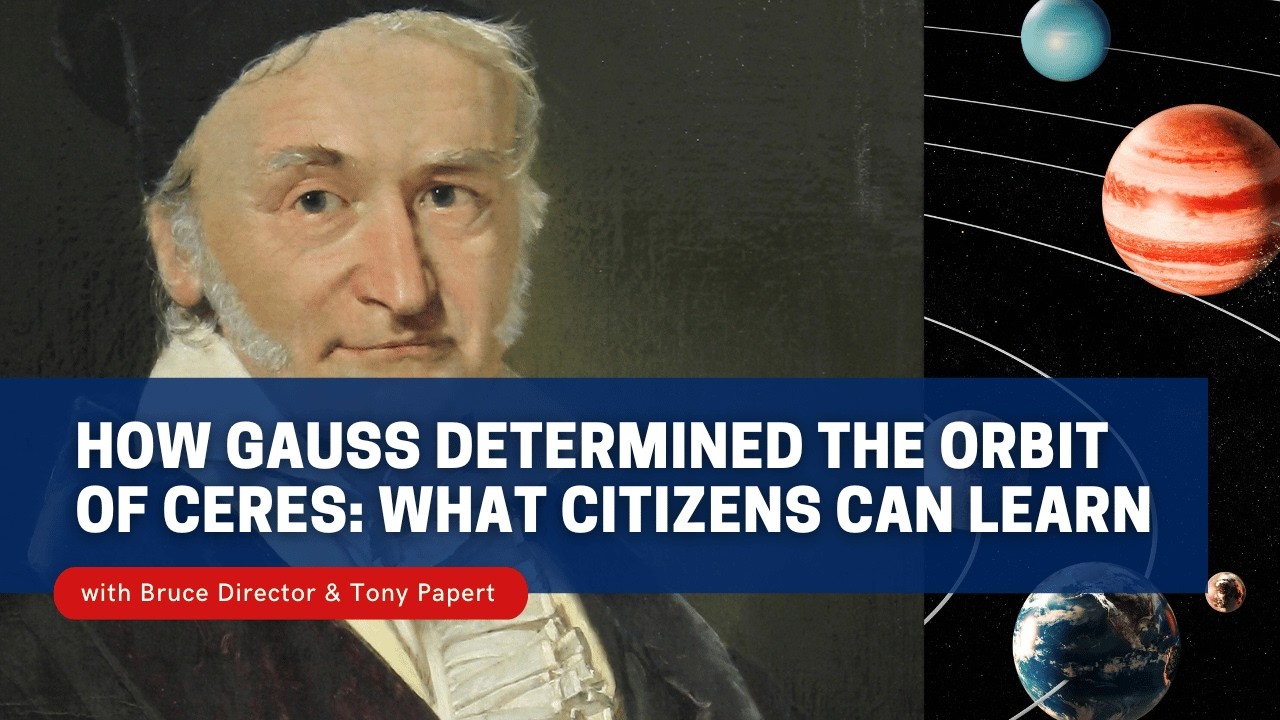
Saturday Class - How Gauss Determined the Orbit of Ceres - May 30, 2026
Every leading astronomer in Europe tried to find the lost asteroid Ceres with statistics. Every one failed. An unknown 24-year-old, Carl Gauss, found it from 41 days of data — by refusing to calculate and insisting on principle. Bruce Director on why that method is the cure for the age of AI.
Every astronomer in Europe tried to find the lost planet with statistics. They all failed. One man used his mind.
On January 1, 1801, a Sicilian astronomer named Giuseppe Piazzi spotted a point of light no one had ever catalogued. He tracked it for 41 nights — and then it slid into the glare of the Sun and vanished.
It was Ceres: the first asteroid ever found, orbiting in the gap between Mars and Jupiter where Kepler had predicted a missing planet ought to be. And now it was gone.
Forty-one days. A sliver of an arc — with a faint kink of retrograde motion buried inside it. From that scrap, every leading astronomer in Europe set out to compute where and when Ceres would re-emerge from behind the Sun. They reached for the tools we still worship today: curve-fitting, data-smoothing, statistical methods. Every one of them got it wrong.
Then a relatively unknown 24-year-old mathematician in Germany — Carl Friedrich Gauss — made his own prediction. On December 31, 1801, two astronomers aimed their telescopes exactly where Gauss told them to look. Ceres was there.
Why a political movement is teaching you astronomy
Bruce Director — a longtime collaborator of Lyndon LaRouche and one of Promethean Action's most rigorous teachers — opens this class by meeting the obvious objection head-on: what does a 19th-century asteroid have to do with politics?
Everything, as it turns out. As Bruce recounts, when LaRouche was asked in 1997 how he had forecast the Asian financial crisis that every mainstream economist missed, he answered: for the same reason Gauss determined the orbit of Ceres. It is a method of thinking — and it is the opposite of the one our schools, our markets, and our machines now run on.
Statistics describe. Principle discovers.
Here is the distinction Bruce draws out. The astronomers who failed treated the problem as data: collect enough points, fit a curve, extrapolate. But a 41-day arc can be fit by infinitely many curves. Statistics can only ever describe what you have already seen. It can never tell you the cause.
Gauss refused to play that game. He started instead from physical principle — from what Kepler had already proven about how bodies actually move around the Sun:
The orbit had to lie in a single plane passing through the center of the Sun.
The body had to sweep out equal areas in equal times — so the ratio of the areas was fixed by the ratio of the elapsed days, 21 to 20.
The whole motion could be referred back to the one orbit we already know with precision: the Earth's.
From those constraints, all the forbidding geometry collapsed onto a single unknown: the relative distance from the Sun to the middle observation. Gauss estimated it, refined it, applied his formula just three times — and the entire orbit fell out. Its size, its eccentricity, its inclination, its period.
You only know a few things, and yet you have to understand the universal processes at work that are causing them to behave the way they behave. — Bruce Director
That, he argues, is the essence of science — and of history, economics, and politics. Reasoning from the very small to the universal principle acting within it. It is also, not coincidentally, a deeply Promethean act.
I also taught man the rising and settings of the stars, which are very hard to understand. — Prometheus, in Aeschylus's Prometheus Bound
The same fight, in 2026
Bruce closes with a story that lands like a verdict. Searching recent scientific literature, he found AI researchers citing the very paper he co-wrote on Gauss and Ceres — citing it to claim that the statistical methods AI relies on trace all the way back to Gauss. The exact opposite of what the paper says. In all likelihood they had used AI to find a source, and the machine handed them a citation that argues against them.
That is the crisis in miniature. We have built a culture — and now a technology — that mistakes describing the data for understanding the cause. It produces citizens who can calculate endlessly and discover nothing: exactly the kind of mind every empire from Babylon to Brussels has needed in order to govern.
The cure is the one John Quincy Adams pointed to at the end of his life, when he made the arduous trip to dedicate the Cincinnati Observatory and spoke about the bond between astronomy and the principles of the Declaration of Independence. It is the cure Gauss embodied: the conviction that the human mind can know real causes — and that a self-governing people had better be able to.
Watch the full class — and send it to anyone who still believes the machine does the thinking.
Further reading
Bruce promised to post his references. Here they are:
How Gauss Determined the Orbit of Ceres — Bruce Director and Jonathan Tennenbaum's full Fidelio treatment of the discovery, with the diagrams and derivations.
PS: The 2026 midterms will determine whether President Trump's agenda survives and accelerates — or gets reversed and crushed.
Our Midterm Bootcamp is a semi-monthly training series equipping activists, candidates, and grassroots leaders with the ideas and messaging to win. Sign up and check your email for the next session's Zoom link.
SUPPORT PROMETHEAN IN-DEPTH!
Every Saturday, Promethean Action hosts live classes on the scientific, cultural, and historical material needed to rapidly develop educated citizen leaders. These aren't surface-level overviews—they're rigorous, in-depth sessions built to sharpen how you think and equip citizens to lead.
Keep these classes 100% independent by becoming a paid subscriber for just $10 a month.
If you value scientific truth that challenges the status quo and want a front-row seat to material that builds real understanding, become a paid member now and join us in championing human progress.
America went from candles and the horse and buggy to telephones, cars and airplanes, in one lifetime. Bob Ingraham shows how tariffs and Hamiltonian credit did it, and why the same tools, back in play today, can do it again.
Why “super” and not “artificial”? Brian Lantz shows SI at work in an Arizona copper mine, aimed at a nuclear-powered Moon, and in service of new forms of human creativity. Watch the full class.
Two conductors. One score. Two opposite ideas of man. This week's Class puts Furtwängler against Toscanini — and tonal against atonal. The fight over your ear is the fight for your children's future.
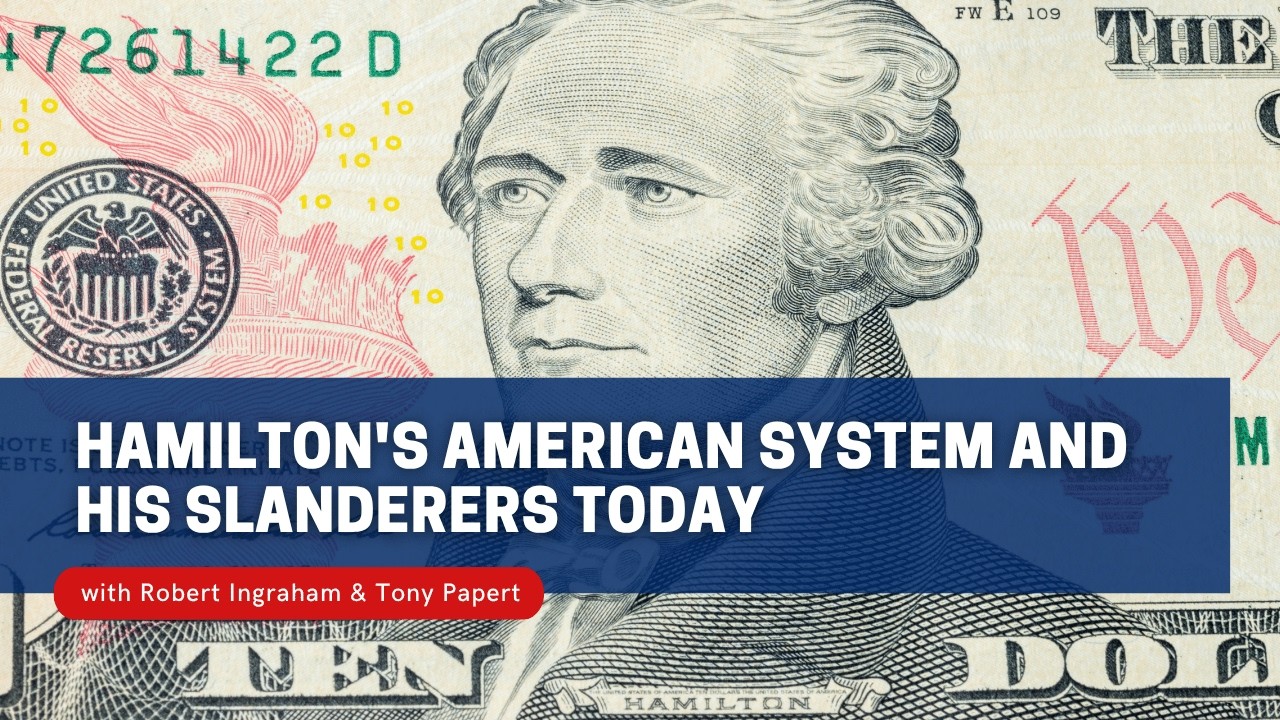
Bob takes on the slanders against Alexander Hamilton and the British-finance axioms most Americans still carry — and why Hamilton's bank is not the Fed.