Trump’s industrial revival collides with demands to restrict AI. Mike examines Fetterman, Anthropic, Effective Altruism, and the battle over America’s economic future.
Scotland, Wales, and Northern Ireland’s first ministers push independence as Labour betrays Brexit. Carney’s Canada–Ukraine 100-year pact, EU associate talk, and rate-hike “noise” target Trump’s midterms.
As Hurricane Helene devastated the Southeast and Hurricane Milton is bearing down on Florida, the media, as expected, is trying to blame climate change (in line with past claims by Kamala Harris and Tim Walz). These are simply lies. The reality is there is no evidence hurricanes are getting worse in response to the slight warming we've seen over the past couple hundred years.
Even the U.S. Government’s own 2014 National Climate Assessment admitted, “there has been no significant trend in the global number of tropical cyclones nor has any trend been identified in the number of U.S. land-falling hurricanes.” And the UN's infamous IPCC, admitted in their 2018 interim report, “[there is] only low confidence for the attribution of any detectable changes in tropical cyclone activity to anthropogenic influences.”*
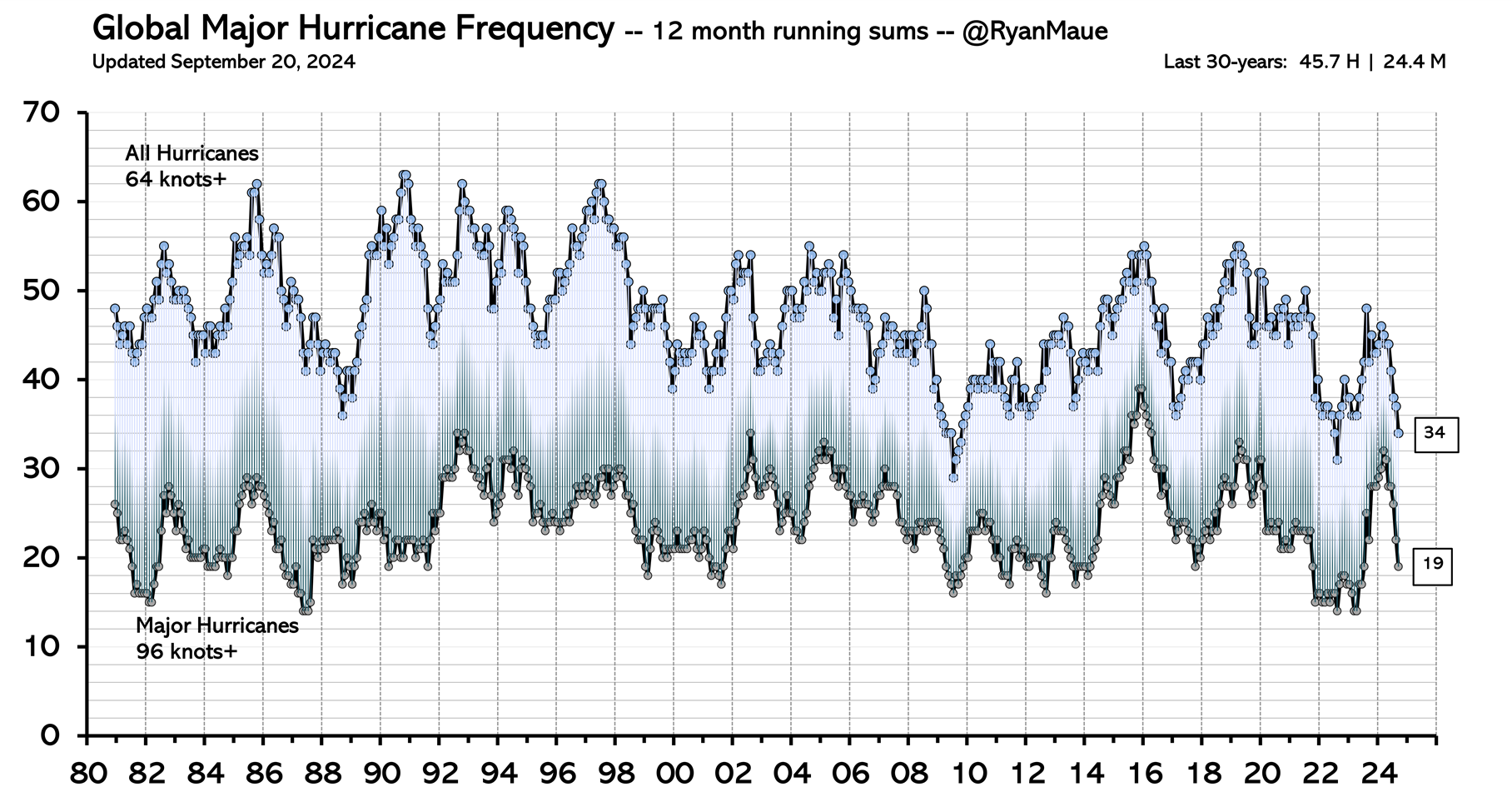
This is abundantly clear when you simply look at global counts of hurricanes and cycles each year or measurements of total energy of hurricanes and cyclones each year (using the "accumulated cyclone energy" (ACE) metric). There is absolutely no upward trend corresponding to increasing CO2 levels. The work on global tropical cyclone activity by Dr. Ryan N. Maue provides some excellent graphs showing this clearly.
Dr. Maue's graphs makes the truth abundantly clear.
In the spring of this year, some meteorologists were forecasting 2024 would be a bad year for hurricanes. But, this was based on known ocean cycles which have nothing to do with climate change (specifically the Atlantic Multi-decadal Oscillation). This was a basic forecast, unrelated to how much CO2 your car, your lawnmower, or the local power plant puts into the atmosphere. While it’s true there has been a gradual increase in the earth’s temperature, human activity is only a minor factor in causing this. And there is no observational evidence for an increase in hurricanes or cyclones in response to this slight warming. It’s time Americans disavow the pagan religion of “climate change” and get a bit smarter. And we may soon have leaders in Washington who will stand up to this nonsense.
*These quotes are unfortunately not representative of the final claims that get attributed to the U.S. Government’s National Climate Assessment or the United Nations Intergovernmental Panel on Climate Change (IPCC). In both organizations, many competent scientists contribute to the making of their assessments. However, the often complex and nuanced work of the individual scientists is edited and condensed by a selected team of scientists into an “assessment report,” which often glosses over many of the nuances and in some cases emphasizes an illegitimate bias of a writer of the assessment. The assessment reports are then taken by science reporters of the popular press, who also often have a bias which further exaggerates a message. This process is well described in the book, “Unsettled: What Climate Science Tells Us, What It Doesn’t, and Why It Matters,” by Steven Koonin.
In the tradition of Prometheus and Lyndon LaRouche, we seek to deploy science, art and history to unseat our present failing Olympians while lifting our People up to their greatest creative potential.
Bruce Director digs into your comments from the Aug 29 class: why the British System is inherently entropic, why no equation can predict a creative discovery, and how frontier science backs the American System’s idea of man.
Cable news is arguing eggs, beef, gas, and Iran. Bruce Director spent Saturday night on the real midterm question: American System vs. British System — two flavors of the same entropy, and nine weeks to pick a future.
Chatbots dominate the AI argument. Brian Lantz spent Saturday night on the other kind — robots, machine shops, and factory floors — and why manufacturing, not the data center, is where the country actually gets richer.
Four new nuclear reactors went critical in a single month — America's first in 40 years. Brian Lantz on the factory boom the media won't name, and the apprenticeship programs that pay you to help build it. The hardest problem was never the physics.