Two conductors. One score. Two opposite ideas of man. This week's Class puts Furtwängler against Toscanini — and tonal against atonal. The fight over your ear is the fight for your children's future.
Media howled over an autopen joke and the Xi summit—while Trump dismantles Kissinger’s 50-year framework, Xi says the Thucydides Trap can be overcome, and Rubio permanently holds both State Dept. and National Security Advisor.
Barbara Boyd’s new 47-page briefing is free for paid Promethean Action members. It names the real enemy in the 2026 midterms: an Empire that has used both Wall Street and the Communist mob against the American System — and is trying again.
Saturday Class - Classical Music: The Highest Expression of the Creative Human Mind - September 26, 2026
Two conductors. One score. Two opposite ideas of man. This week's Class puts Furtwängler against Toscanini — and tonal against atonal. The fight over your ear is the fight for your children's future.
In this week’s Saturday Class, Toni Sellars and Mindy Pechenuk (with Tony Papert) took on the question most Americans have been trained not to ask: why classical music matters for the nation-state.
Play the same symphony twice. The notes are identical. The orchestra is world-class both times.
Yet one performance breathes. The other marches.
One carries you somewhere. The other keeps time.
That difference is the whole lesson. It is not a matter of taste. It is a question about what a human being is.
Classical music is the highest expression of the creative human mind. And the oligarchy has spent a century trying to make you forget it.
Cream in the Coffee
Toni opened with Melania Trump’s Fostering the Future Together — empowerment begins by giving a child the confidence that their mind has value. Then she gave the cream-in-coffee image.
If you like black coffee and someone puts one drop of cream in it every day, you never notice the change. In six months you are drinking something else.That is how the enemy works on culture. Not with a sudden ban. With a slow redefinition of who you think you are.
If man is made in the image of the Creator, your art will reflect that. If you are trained to see man as an animal, your art will reflect that too.
Two systems. Two images of man.
The American System bets on creativity. The British oligarchical system bets on entropy — a population that no longer believes it can create anything at all.
Lawful Freedom vs. Noise
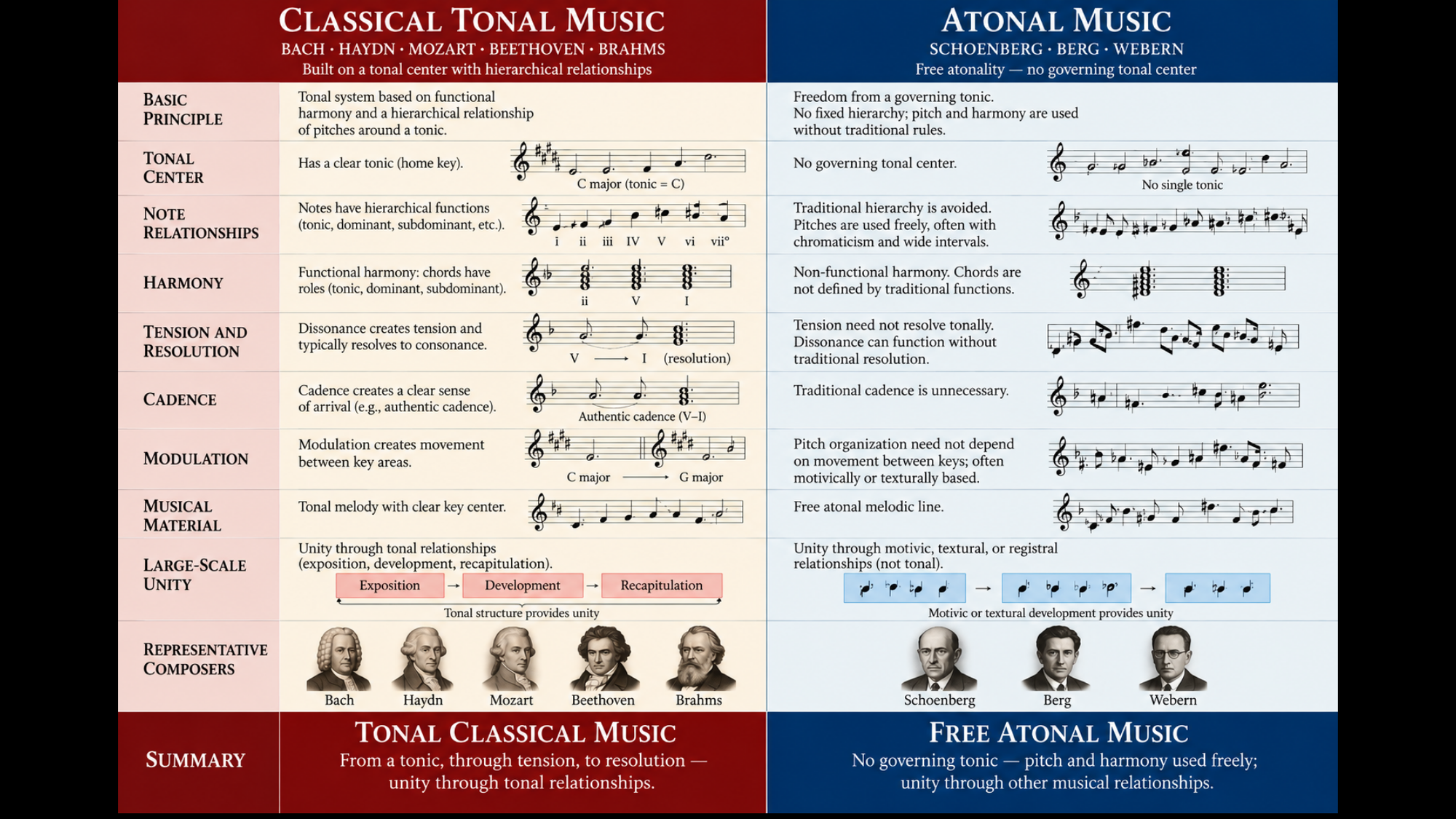
Classical tonal vs. atonal — chart shown in class
Tonal music is lawful freedom. Bach, Mozart, Beethoven, Schubert, Brahms work inside a lawful order. Inside that order they invent without limit.
Tension builds. Tension resolves. The mind travels and arrives.
Atonal music breaks the law and calls it freedom. Schoenberg, Berg, Webern gave dissonance with no resolution. The tension never goes anywhere.
Wilhelm Furtwängler put it better than anyone:
Each great work of tonal music radiates deep, unshakable peace, like the majesty of God. This peace is lacking in atonal music, which grows restless. Listening to atonal music is like walking through a dense forest. Strange flowers are lining the path. You don’t know whence you come, and you don’t know whither you go.
— Wilhelm Furtwängler
No origin. No destination. That is not art. That is a map of the psyche the oligarchy wants you to have.
The Stepping Stone
Mindy made it concrete with two settings of the same text — Ave Verum Corpus.
First, Mozart, sung by the Houston chorus. Luminous. Brief. A celebration of the immortality of the human soul.Then Liszt. Darker. Chromatic. A dirge. The sound of estrangement — man cut off from his Creator.Liszt and Wagner were the stepping stone. After them came Schoenberg’s twelve-tone row and his “emancipation of the dissonance.”
A twelve-tone row is an arbitrary order. The composer simply declares it. Nothing is discovered. Mindy drew the parallel. Arbitrary order in music is cultural anarchy — the same anarchism that tells a child his nature is just a choice.
Then John Cage: an organ piece scheduled to last 639 years. Nobody will ever hear it whole. When there is no whither, nothing needs to arrive.
This Was Done on Purpose
None of this is accidental. After McKinley was assassinated, the floodgates opened for Wilson, the Federal Reserve, and the income tax. Monetarism took the wheel.
After the assassinations of the 1960s, the operation ran again. Drugs. Rock. The cult of “me.” Tavistock and the intelligence networks did not invent that by accident.
Each time, the political coup came with a cultural one.
You cannot destroy a sovereign nation until you destroy it through its culture — until the individual is redefined as a thing in himself.
The difference for man is the human mind, the ontology of living with the future rather than the mere present. That is the true essence of the actual meaning of human creativity, and also even the meaning of humanity itself.
— Lyndon LaRouche, A Lesson from Furtwängler (2012)
Furtwängler vs. the Time-Beater
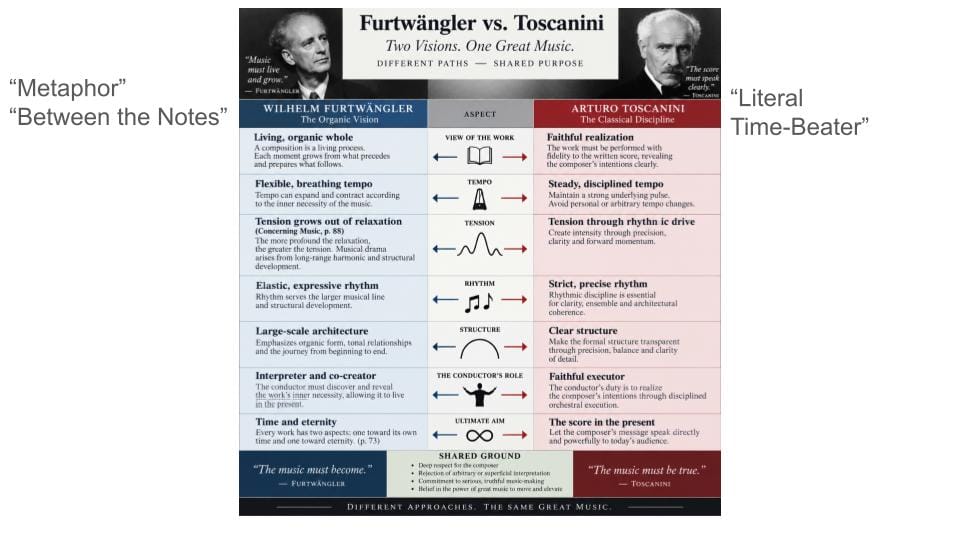
Wilhelm Furtwängler — chart shown in class
Toscanini was the time-beater. Precise. Literal. Loyal to the notes on the page.
What he lacked: organic development. Long-range harmonic understanding. Spiritual depth.
Furtwängler conducted between the notes.
The score is footprints. The idea the composer was reaching for lives in the relationships, the tensions, the destination. A great conductor rediscovers that idea. He does not just execute instructions.
In Concerning Music, Furtwängler describes tension and relaxation as mutually dependent. A true masterpiece radiates peace — a reflection of the glory of God.He contrasted two kinds of crowd. A Beethoven audience becomes a real community, lifted together. A boxing-match mob is only a mass, agitated together.
He warned against “effects without causes” — Wagner-era sensationalism built to hit your nerves instead of your mind.
And he believed music has a political function:
Art does not express a nation’s hate, but its love. … Music, more than any other art, has a political function. It helps nations understand each other through their artists and their music.
— Wilhelm Furtwängler
So of course there was a fight over the podium.
The New York Philharmonic’s oligarchical board wanted Toscanini. Toscanini feigned illness and threatened to cancel unless he took Beethoven’s Ninth away from Furtwängler. It worked. Furtwängler’s last American tour was 1927.
For a century, Americans were trained to hear the metronome and call it music.
Compare Stravinsky’s reductionism: only the present. Only the syllable. Only the beat in front of you. That is Toscanini’s podium. It is Schoenberg’s row. It is the “me” generation.
Furtwängler’s music reaches toward a resolution that has not arrived yet. That is what a creative mind does. That is what a republic does when it builds for grandchildren it will never meet.
Your listening homework
Do the test yourself. Listen twice. Ask one question: What is different?
1) Schubert, Unfinished Symphony No. 8 — Furtwängler vs. Toscanini
Life long organizer for the noble ideas of Lyndon LaRouche, and dedicated to creating a cultural and scientific renaissance that can bring out the best in everyone.
Founding member of the LaRouche movement in the 1960s. Former editor of LaRouche’s writings and EIR magazine. Regular host of our Saturday class series.
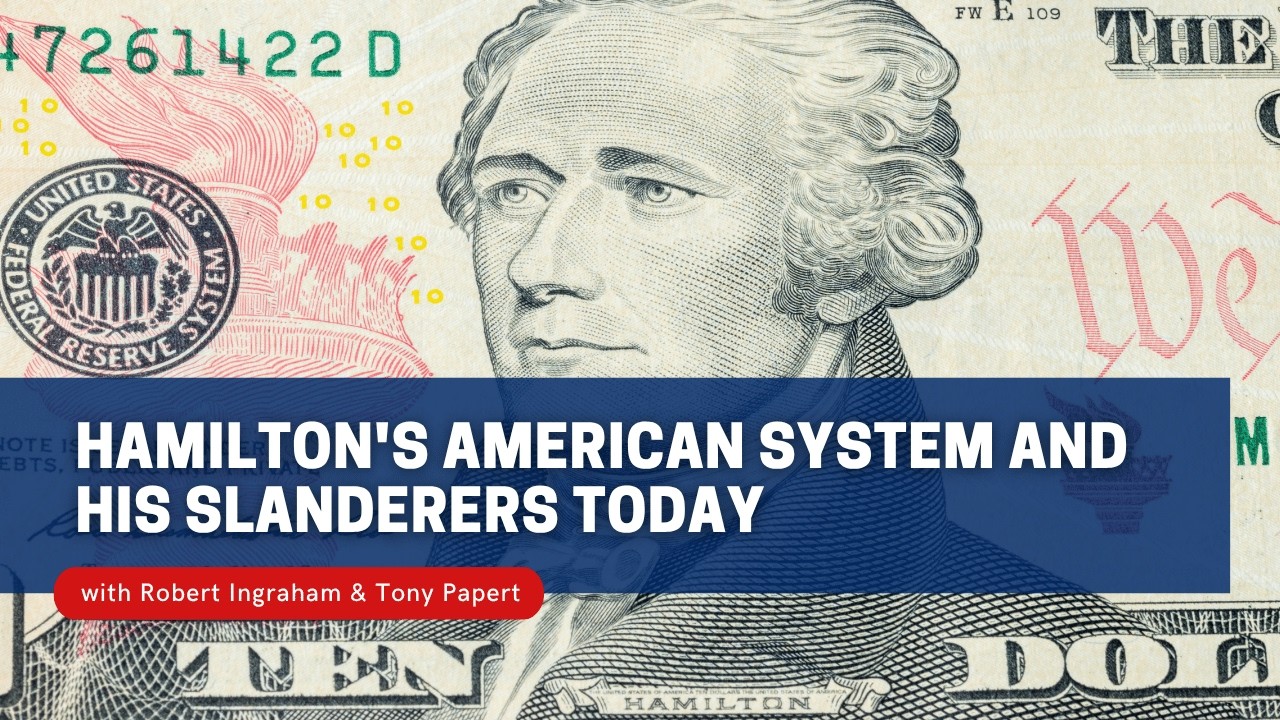
Bob takes on the slanders against Alexander Hamilton and the British-finance axioms most Americans still carry — and why Hamilton's bank is not the Fed.
Bruce Director digs into your comments from the Aug 29 class: why the British System is inherently entropic, why no equation can predict a creative discovery, and how frontier science backs the American System’s idea of man.
Cable news is arguing eggs, beef, gas, and Iran. Bruce Director spent Saturday night on the real midterm question: American System vs. British System — two flavors of the same entropy, and nine weeks to pick a future.
Chatbots dominate the AI argument. Brian Lantz spent Saturday night on the other kind — robots, machine shops, and factory floors — and why manufacturing, not the data center, is where the country actually gets richer.