President Trump, Xi Jinping and Vladimir Putin are meeting in Shenzhen, the first summit ever of the U.S., China, and Russia leaders. The press calls it Yalta 2.0; Susan Kokinda argues London really fears a Bretton Woods 2.0, and follows the gas-price trail back to 1971.
Barbara ties Senator Elissa Slotkin’s call to Trump-proof the government to SpaceX catching a Starship and the expected Trump–Xi–Putin meeting: the party that called itself the party of progress is now running on stopping it.
Marco Rubio lays out a vision for America's future as Trump moves to rebuild the nation's infrastructure, restore American industry, and build a winning coalition for 2028. From air traffic control to AI and energy, it's time for the great American rebuild.
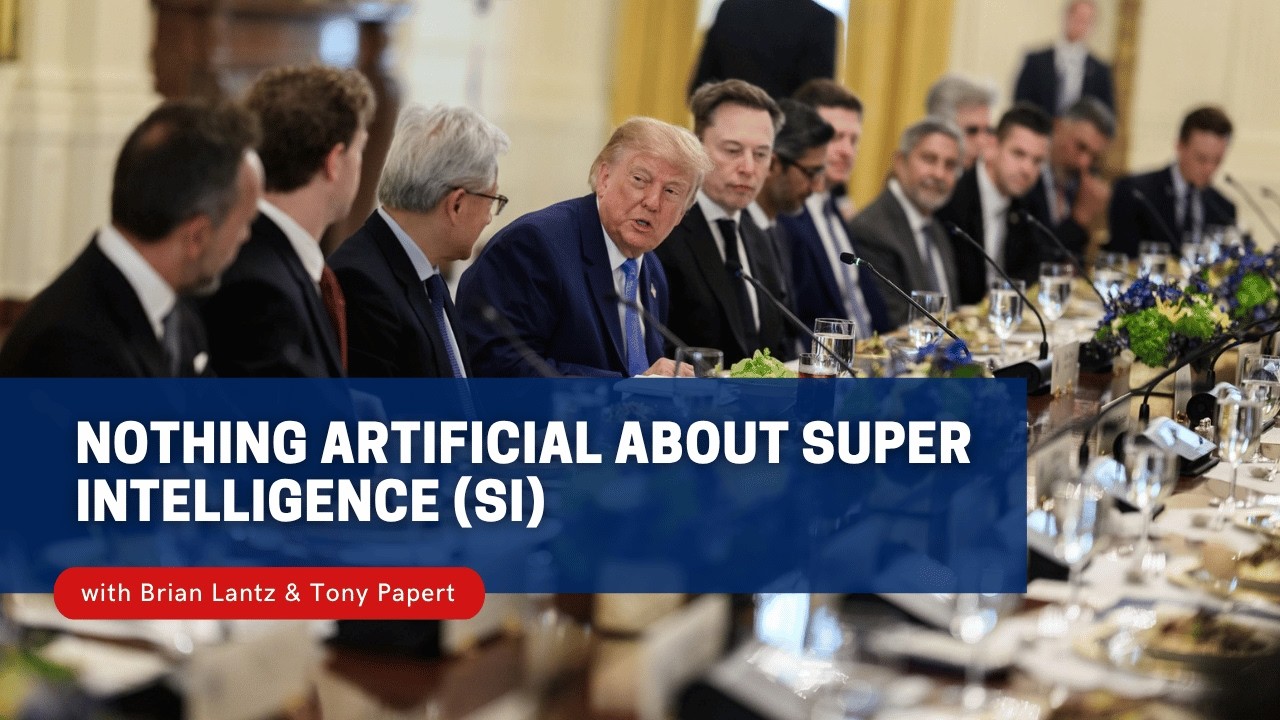
Saturday Class - Nothing Artificial about Super Intelligence (SI) - October 3, 2026
Why “super” and not “artificial”? Brian Lantz shows SI at work in an Arizona copper mine, aimed at a nuclear-powered Moon, and in service of new forms of human creativity. Watch the full class.
In this week’s Saturday Class, Brian Lantz, with host Tony Papert, asked a question most of the “AI” debate skips: what is superintelligence — SI — actually for?
Brian’s answer starts on the factory floor and ends with Plato. Along the way, it overturns most of what you have been told about the machines.
Physical Intelligence
A few years ago, an American entrepreneur was looking for a hack — an app that could go on a phone and make money. Today serious capital is going into real product. Shipbuilding. Nuclear advances. Steel mills. Starship inserted into Earth orbit on September 28.
Now we’re moving steel, we’re producing steel, we’re building things again in the real world.
— Brian Lantz
That is where Brian puts SI to the test. He calls it physical intelligence: SI applied to making physical changes on nature for man. The measure is real productivity, rising living standards, and growing young families — not backroom paper-shuffling.
It is a sharp line. Watch the class to see how Brian draws it, and why the Democrats’ hoped-for data-center scare is, in his words, going up in a big cloud of smoke.
From the Copper Mine to the Moon
Brian’s proof is concrete. At Freeport-McMoRan’s Bagdad copper mine in Arizona, 33 autonomous Caterpillar haul trucks have moved 50 million tons. Sensors on each truck read the exact ore it carries. The processing plant adjusts before the truck even arrives. Output is up 10%.
Now take those same autonomous machines to dams and inland waterways. Then take them to the Moon. NASA’s Jared Isaacman has set a blunt course: a nuclear-powered space vehicle by 2028 and a nuclear power plant on the Moon by 2030.
Brian also brings an honest caveat. The human brain runs on about 20 watts. A squirrel leaps from tree to tree on a fraction of one. A humanoid robot needs 500 to 700 watts just to stand still. The full class shows why that gap matters — and why it points back to the human mind.
Why “Super,” Not “Artificial”
Here is the heart of the class. Why did President Trump call it super intelligence and not artificial?
The White House fact sheet inaugurating the era of superintelligence says the name conveys what the technology can do: “unlocking new forms of human creativity.” Not a gadget here or there. New forms of creativity.
Brian ties that to the Genesis Mission, which brings together leading technology companies and all 17 national laboratories. And he ties it to what Plato called the hypothesis of the higher hypothesis.
The question is not merely to improve knowledge incrementally, but we need to generate the new hypotheses that supersede the way we think.
— Brian Lantz
The machines do not make the discovery. Young scientists do, with better tools and data that is no longer siloed. Brian raised this for discussion “not just here, but in the coming weeks.” Watch the class and get in on the ground floor.
Go Deeper With Brian
Brian pointed viewers to two places to keep going.
His book, Rebuild the USA: The Trump Presidency and Beyond, lays out the sector-by-sector case for an American industrial rebirth. And his free Substack, Physical Economics, tracks the build-out as it happens — mines, steel, nuclear, and the factories behind them.
Read the book for the blueprint. Subscribe to the Substack to watch it happen.
In the full class, Brian goes much further — the Iron Range and a new Iowa steel mill, microreactors, surgical robots, and autonomous Navy ships. It is a picture of an America building again, and of the creative minds that make it possible.
Expert in the almost forgotten science of physical economy. Basing his interventions on fundamental concepts, he’s engaged in a far-ranging dialogue to shape the future of our economy & culture.
Founding member of the LaRouche movement in the 1960s. Former editor of LaRouche’s writings and EIR magazine. Regular host of our Saturday class series.
Hamilton called him "the great Colbert." Judy Hodgkiss shows how a French minister's canals, credit, and Academy of Sciences began to wriggle France free of Amsterdam — and how that design reached the Erie Canal.
Is it constitutional for the federal government to help rebuild American industry? Brian Lantz says hell yes, and traces the American System from Article I, Section 8 through Hamilton, Lincoln and national credit.
Bob Ingraham shows how Hamilton turned Revolutionary War debt into public credit — and why Bessent's growth fight with the IMF is the same war over who decides America's economic destiny.
Four young organizers took the American System onto Michigan campuses. Hear what Gen Z said, what they found undercover, and the challenge they're putting to you.