Susan reads Canada's rap sheet — transshipment smuggling, forced-labor failures, snow-washing — and contrasts Chris Wright's civilizational case for energy with Joly's "geo-industrialization," as a Green Party petition targets Ambassador Hoekstra.
Hillary Clinton backs Trump’s Gaza peace plan as Democrats fracture. Can Republicans turn Trump’s working-class agenda into a winning coalition before the midterms?
Broken sailors on the USS Lincoln is textbook cognitive warfare — and Barbara Boyd shows why attacking American troops' resilience is the psywar mistake that will haunt London and the Democrats through the midterms.
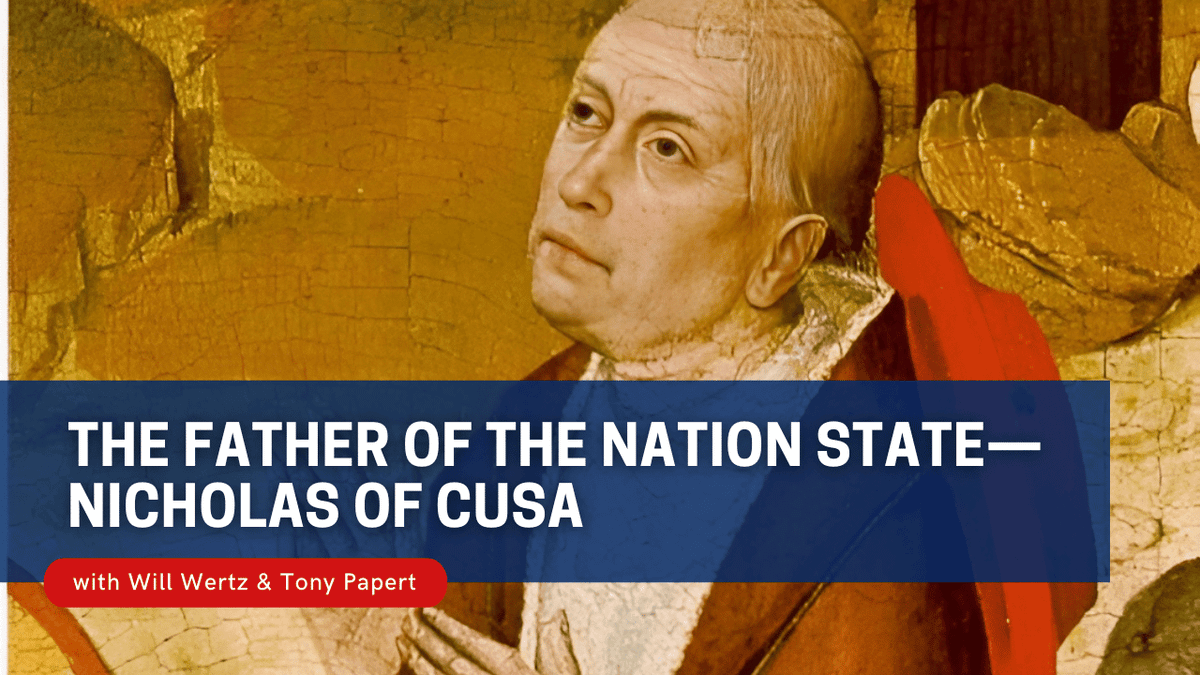
Will Wertz, a long-time close associate of Lyndon LaRouche, will give the second of two classes on the contributions of Nicolaus of Cusa (1401-1464) to physical science and the political economy of the American System. Wertz was jailed along with Lyndon LaRouche in 1989, in a judicial railroad which presaged those against Donald Trump.
During his imprisonment he translated many of the works of Nicolaus of Cusa, who was the organizer of the Council of Florence, which gave rise to the Italian Renaissance.
Nicolaus of Cusa disproved Ptolemy’s idea that the earth was the fixed center of the universe—an idea that prevailed and was enforced for nearly 1500 years—thus laying the basis for Kepler’s revolution in astronomy.
His refutation of Aristotle and his adoption of Plato’s method led to Georg Cantor’s notion of the transfinite.
He refuted the notion that the universe is entropic, a pseudo-scientific Newtonian/Malthusian view that still prevails today. This laid the basis for Leibniz and LaRouche’s notion of anti-entropy.
His view that there are three domains: being, the living and understanding—laid the basis for Vernadsky’s concepts of the non-living, the biosphere and the noosphere.
And his concept of Actual Potential or Potential Itself, is the basis for Lyndon LaRouche’s concepts of the necessary increase in potential relative population density and energy flux density.
In short, Nicolaus of Cusa was a universal genius whose ideas are relevant to our solving the crisis which today threatens the very survival of our Republic, and indeed the very survival of the human species.
The second class, on June 15, will cover Cusa’s contributions to physical science. Tony Papert will moderate the discussion.
Founding member of the LaRouche movement in the 1960s. Former editor of LaRouche’s writings and EIR magazine. Regular host of our Saturday class series.
Nixon called it “temporary.” 55 years later it’s still policy. Will Wertz reads the paper trail — the secret Kissinger memo, the Volcker Group, Britain’s run on Fort Knox — and the principles of the new Bretton Woods Trump’s Treasury says is underway.
In 1775, Americans and Quebec militiamen fought as brothers to free Canada from the British crown. Bob Ingraham on the lie of the "invasion," Franklin's near-miss at the peace table — and why, 250 years later, the question is open again.
Four new nuclear reactors went critical in a single month — America's first in 40 years. Brian Lantz on the factory boom the media won't name, and the apprenticeship programs that pay you to help build it. The hardest problem was never the physics.
A full-size statue of Beethoven once stood behind the Boston Symphony. Toni Sellars and Mindy Pechenuk on how deep this music ran in 19th-century America — and who spent the next century getting it out.