They rewrote your history. A suppressed 400-page manuscript — hidden for 230 years — reveals the true philosophical war behind the American Revolution. Charles Park traces the direct line from Leibniz through Logan and Franklin to the founding of the republic.
Trump's 5-year plan demolishes London's Iran oil scam. Barbara Boyd exposes the Iran Terror Premium — $10 trillion drained over 25 years — and the nuclear century Trump and the Gulf States are building to replace it.
What Is Promethean Man? — In Defense of Science from Corruption
The step-by-step destruction of the U.S. economy over the last two generations goes beyond simply bad policies. There are deeper cultural and philosophical elements that need to be addressed, centering around a corrupted view of mankind’s place in the universe.
The following article is an extended version of the last section of our just released "What President Trump Can Do With The American System 2.0."Download your FREE copy. Most recent update was done on February 2, 2026.
The step-by-step destruction of the U.S. economy over the last two generations goes beyond simply bad policies. There are deeper cultural and philosophical elements that need to be addressed, centering around a corrupted view of mankind’s place in the universe. Addressing this creates the basis for a classical cultural renaissance that embraces and celebrates the true dignity of man.
From radical environmentalists claiming today’s great moral act is to not have children, to ivory tower academics telling us human beings are fundamentally no different than animals, core notions about the fundamental dignity of man have been under attack. To a large degree, academic and scientific institutions have been leading the way in this cultural and philosophical shift.
Many Americans awakened to the depths of corruption in our scientific establishment after living through the absurdities of COVID lockdowns. Others had noticed the corruption earlier, while being subject to the repeated mantra of climate change catastrophes that never actually occur. But control over academic institutions and abuse of the authority of science for political control is not new. In his famous 1961 farewell address in which he warned of the growing power of a military industrial complex, President Eisenhower went on to warn about the dangers of political control over academic institutions and the capture of political institutions by “a scientific-technological elite” (Eisenhower, 1961).[^ President Eisenhower said, “The prospect of domination of the nation's scholars by Federal employment, project allocations, and the power of money is ever present—and is gravely to be regarded. Yet, in holding scientific research and discovery in respect, as we should, we must also be alert to the equal and opposite danger that public policy could itself become captive of a scientific-technological elite.” (Eisenhower, 1961) ]
What President Trump Can Do With The American System 2.0
Our latest pamphlet release is hitting the streets across the country.
Under this corruption, the general scientific consensus is that mankind is nothing more than another animal species, with life itself being nothing more than a temporary, random chemical occurrence in a universe that’s ultimately heading towards an entropic heat death, in which any and all actions you take during your life are ultimately meaningless.
This is what our children are being taught today. Is it any wonder how far our culture has degenerated?
But is this what science actually says, or is this the product of scientific institutions operating under the corruption of an anti-human, oligarchical ideology?
As we’ll see here, an unbiased, uncorrupted scientific study of mankind’s place in the universe shows the opposite. When our founding fathers declared the independence of our soon-to-be nation, they looked to the highest truths of natural law as the basis for justifying their actions.
We hold these truths to be self-evident, that all men are created equal, that they are endowed, by their Creator, with certain unalienable rights, that among these are life, liberty, and the pursuit of happiness.
-U.S. Declaration of Independence, 1776
Some may argue these are simply nice conceptions. Here, we show that this is the only scientifically valid basis for government, as the following picture of mankind’s place in the universe demonstrates mankind’s unique position as the highest expression of creativity in an inherently creative universe.
1. Our Creative and Developing Universe
We have a specific metric that allows us to examine the most fundamental processes of development of the entire universe and the activities of mankind in one coherent picture: power per mass, measuring energy consumption per time per mass.[^ Here we'll use watts per kilogram (W/kg). The measurement of energy per time per mass was developed by Harvard professor Eric Chaisson, which he calls energy rate density (Chaisson, 2014). This metric is very close to the metric of energy flux-density developed by physical economist Lyndon LaRouche. However, while the metrics are similar, the methodological perspective of LaRouche differs from Chaisson’s significantly, and this author favors LaRouche's methodological perspective.]
Utilizing this universal metric, we can measure the development of stars and galaxies, the evolution of life and the biosphere, and the development of human society all on one scale. These are the core evolving systems that determine the overall complexity and potential of the universe, and our universal metric of power per mass clearly shows mankind as a unique creative force in a creative universe.
Stars and Galaxies
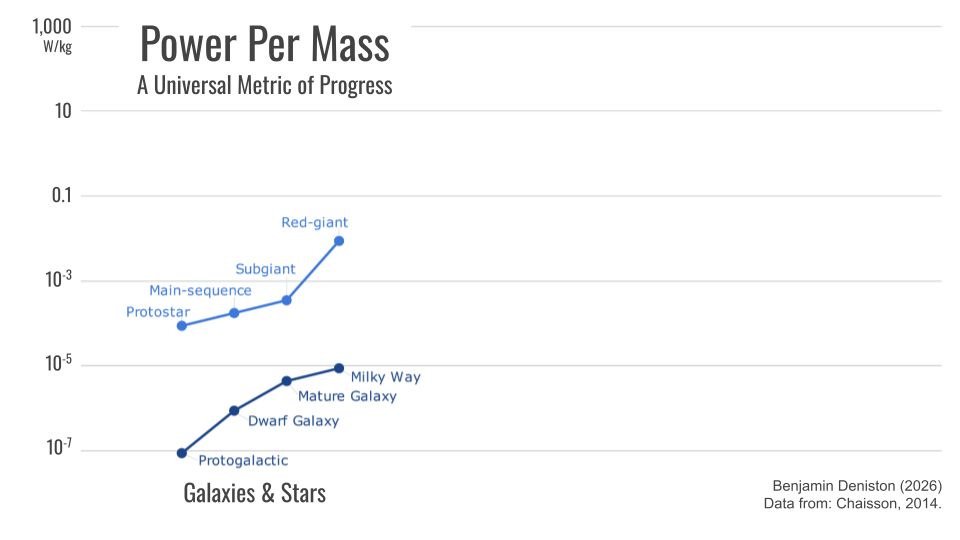
Starting with the astronomical, let’s examine the evolution and development of entire galaxies and, then, individual stars. For galaxies, the evolution from the earliest stages of formation to a well-formed galaxy, like our own, will be measured by about a 50-fold increase in power per mass (Chaisson, 2014).[^ The power per mass of stars and galaxies is derived by comparing their mass with their energy output. ] However, this is mostly determined by the stars that compose the galaxies—with the least-developed stars operating at a level 10-fold above developed galaxies.[^ Remember we’re measuring per unit mass, so, even though a galaxy is obviously more energetic in absolute terms, per unit mass, stars are more powerful. For example, the power of our Milky Way galaxy can be measured by its estimated luminosity of 5*10^36 watts, and it’s mass is thought to be about 3*10^42 kilograms, giving an power per mass of 1.7*10^-6 watts per kilogram. Whereas our Sun has a higher power per mass of 1.9*10^-4 watts per kilogram (from a luminosity of 3.9*10^26 watts and a mass of 2*10^30 kilograms). ] For a typical star, from its initial formation stage to the end stages of its life cycle, its own development is measured by about a 100-fold increase in power per mass (Chaisson, 2014).
Graphic by Benjamin Deniston, using data from: Chaisson, 2014.
This development is powered by nuclear fusion, through the combining of lighter elements into heavier elements. Aside from a few of the very lightest elements, this process of stellar nucleosynthesis is responsible for the development of the full periodic table—the oxygen you’re breathing now, the carbon in your body, the iron in your blood, all this was produced by stars through fusion.
Thus, stars transform the more limited chemical potential and complexity of a few initial elements into the full periodic table of over 90 elements (and over 300 isotopes). This is a negentropic process, creating more organized states, with higher complexity and greater potential.
Thus, as the stars go through their lifecycle, they act as negentropic agents, shaping the material and energetic characteristics of galaxies,[^ We see this with recent results from the James Webb Telescope showing that the earliest galaxies have significantly fewer heavy chemical elements, demonstrating that the heavier elements of the periodic table are built up over time by successive generations of stars (Heintz, 2023). ] in a manner that is similar to how life shapes the conditions of the biosphere. This is the first of three sets of pairings between negentropic agents and the systems they define.
Life and the Biosphere
When discussing the evolution[^ When discussing the evolution of life, we're not constraining our views to Darwin’s theory or the modern neo-Darwinian synthesis. ] of life and the biosphere, probably the clearest picture we have covers the past 540 million years (where we have decent fossil records showing how life changed over time). Within this eon, we can compare changes between the age of the amphibians, the age of the reptiles, and the age of the mammals, looking at selected species as general representations of these past evolutionary stages.[^ Since the amphibian and reptilian species alive today aren't necessarily representative of the amphibians and reptiles of past evolutionary periods, here we look at so-called living fossils (species alive today which are thought to have changed little since their emergence in the fossil record as far back as tens or hundreds of millions of years ago). For the amphibians, we're looking at the Hellbender salamander (Cryptobranchus alleganiensis), and for the reptiles, we are referencing the Tuatara (Sphenodon punctatus). For a modern mammal species, we’re looking at the Eastern Gray Squirrel (Callospermophilus lateralis). The respective power per mass values are calculated from the metabolism and average adult mass (Tacutu, 2018). It's worth noting, that these values are pretty similar to what Chaisson provides from an average of modern species (Chaisson, 2014). ]
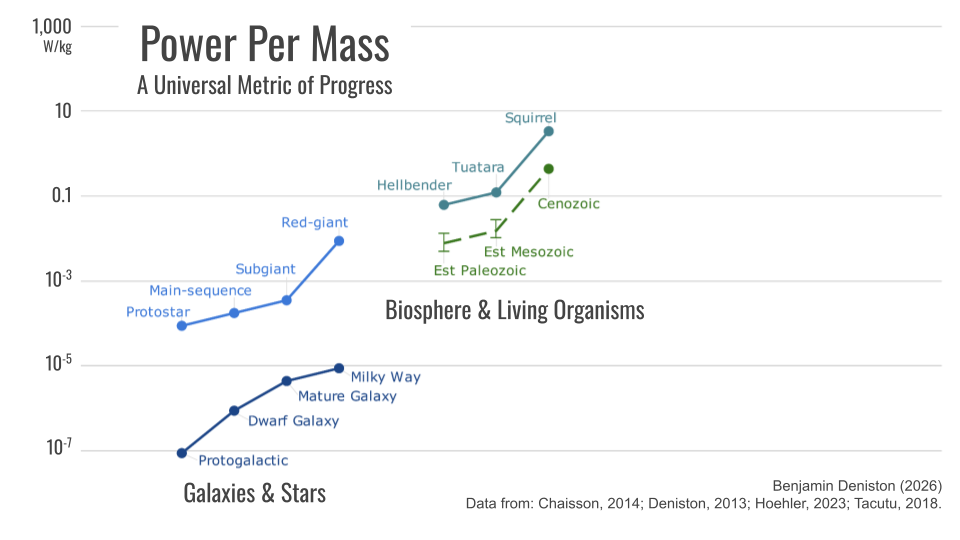
Starting with our representative amphibian, we have an power per mass 7 times higher than a fully-developed star. Our representative reptile functions at twice the rate of the amphibian, and our representative mammal functions at 30 times the power per mass of the reptile (Tacutu, 2018).
Admittedly, just looking at singular species only provides a rough assessment. A better metric would be the power per mass of the biosphere as a whole (accounting for all animal, plant, fungal, and microbial life). Although we have measurements of the current value for the biosphere (Hoehler, 2023), this becomes harder to estimate for past evolutionary periods. Still, various pieces of evidence support the notion that the biosphere as a whole has followed a similar evolutionary energetic growth pattern as our representative species (Deniston, 2013).
Graphic by Benjamin Deniston, using data from: Chaisson, 2014; Deniston, 2013; Hoehler, 2023; Tacutu, 2018.
As with stars and the galaxies they compose, the progress and development of life over evolutionary time is measured by its increasing power per mass. Further, like stars, living organisms act as negentropic agents, defining the material and energetic conditions of their respective system, the biosphere. For example, the biosphere is characterized by a chemical disequilibrium which requires constant activity to maintain.[^ For example, if it weren’t constantly being created by the activity of plant life, all of the free oxygen in the atmosphere would react with other elements and disappear from the atmosphere, as things moved towards chemical equilibrium. The existence of free oxygen in the atmosphere is a manifestation of the chemical disequilibrium created by life. ] The rate of energetic activity of life required to maintain the biosphere’s chemical disequilibrium has been estimated to be 200 terawatts—over 70 times mankind’s current global electricity consumption, and over 200 times what it could be without the continuous action of life (Kleidon, 2012).
Mankind and Physical Economy
This takes us to mankind and the domain of physical economy (as developed by Lyndon LaRouche). For a conceptual reference point representing the emergence of mankind, if we start at a hypothetical purely biological existence, the power per mass for mankind is comparable to any mammalian species. However, since the beginning of mankind’s use of fire, we see mankind depart from merely a biological mode of existence.
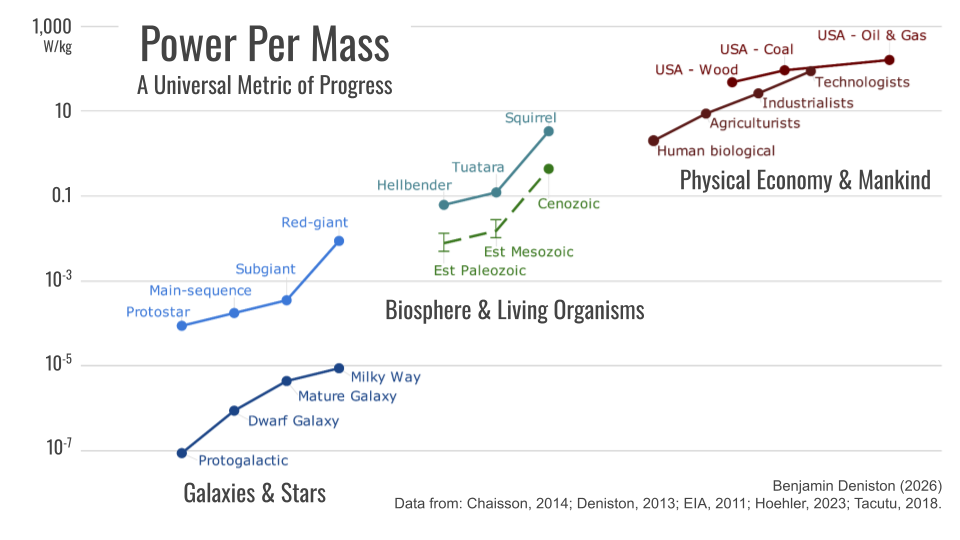
At an agricultural stage of development, the power per mass of the physical economy is four times that of a merely biological existence (Chaisson, 2014). An industrial society operates at a rate that is three times higher than an agricultural society, and a technological society functions at a rate that is three times that of an industrial society (Chaisson, 2014).
We can gain additional insights by defining the stages of human development by the primary fuel source powering the respective economies. Examining the history of the United States as an example, going from the peak of a wood powered economy (in the mid 1800s) to the peak of a coal powered economy (in the early 1900s) corresponded to a doubling of the power per mass of the US economy (EIA, 2011). The transition to the peak of an oil and gas powered economy (in the 1970s) nearly doubled the value again.[^ At the time of President Kennedy’s administration, nuclear fission power was expected to continue this upward trend (Seaborg, 1962), but policy shifts towards the insanity of radical environmentalism, post-industrial society, and globalization largely halted progress for the U.S. economy (Deniston, 2020). ]
Thus, with mankind, we have a third distinct negentropic agent, acting to generate the highest levels of power per mass we see in the universe (in terms of developing negentropic systems). According to our universal metric, mankind is at the apex of a creative and developing universe. The key question becomes, how has mankind been able to do this?
Graphic by Benjamin Deniston, using data from: Chaisson, 2014; Deniston, 2013; EIA, 2011; Hoehler, 2023; Tacutu, 2018.
2. Yes, Mankind is Special
The first section provided a broad overview of our scientific picture of the universe, showing us that the overall complexity of the universe is largely the product of a nested set of developing systems–from galaxies, to the biosphere, to the physical economy–each determined and characterized by their respective negentropic agents–from stars, to living organisms, to mankind.
However, when we look more closely, mankind expresses a capability absent from other negentropic, warranting the core inalienable principles underlying the founding of our nation.
A profound insight into this special nature of mankind goes back to the great legend of Prometheus, who freed mankind from the tyranny of the oligarchical god figures who sought to suppress the masses by denying them basic knowledge.
If we look to Aeschylus’s telling of this legend in Prometheus Bound (More, 1899), Prometheus brought all forms of knowledge to mankind: astronomy, cooking, arts, agriculture, and so on. But, the legend of Prometheus centers around one specific act–the stealing of fire from the gods– with Prometheus being known as the fire-bringer.
In the context of our universal metric, Promethean fire is a unique expression of power per mass. For other negentropic agents, the evolutionary increase in power per mass is tied to changes in the agents themselves—as stars increase their power per mass throughout their individual life cycles, and living organisms increase theirs through biological evolution. However, with mankind, there is no physical change in the negentropic agent itself, instead we see changes that are the products of something unique about the human mind—something we call human creativity.
The Significance of Physical Economy
For the earliest expressions of mankind, we can look back to the use of fire to accomplish tasks that improve the conditions of life—providing warmth, cooking food, and enabling improvements in tool-making. These are activities that changed mankind’s ability to exist, activities that changed mankind’s relation to the natural world.
Rather than our relation to the natural world being mediated by our biology (as with the animals), we see the emergence of the superior mediating factor of human creativity, and the physical expression of creativity in physical economy. From the manufacturing of goods, to the agricultural work that feeds society, to the construction of the infrastructure that society runs on—the physical processes that are required to sustain society have reshaped the natural environment into a higher state of organization and complexity.
Thus, physical economy has a profound meaning as a regime of negentropy that is the expression of human creativity on a societal and generational scale. This becomes a clear and rigorous scientific distinction of mankind from the animals.
Thus, the very nature, existence, and definition of mankind centers around changing the natural world, and bringing increasing levels of the natural world under the domain of mankind’s negentropic sphere of influence.
This points to the scientific validity of God’s mission to mankind in Genesis 1:28.
"And God blessed them, and God said unto them, Be fruitful, and multiply, and replenish the earth, and subdue it: and have dominion over the fish of the sea, and over the fowl of the air, and over every living thing that moveth upon the earth."
What President Trump Can Do With The American System 2.0
Our latest pamphlet release is hitting the streets across the country.
As manifested via physical economy, human creativity appears as the growing encapsulation of the nested processes of creative development of the universe.
For example, under mankind’s management, the current power per mass of the entire biosphere (1 W/kg) is twice what it would have been in its so-called natural state (0.5 W/kg), without human management (Hoehler, 2023). This is the product of the current stage of human society as a well-developed fossil fuel-powered economy. That is, a physical economy powered by the products of the biosphere over evolutionary time (fossil fuels), is a physical economy capable of generating negentropic actions only otherwise seen by biospheric activity over evolutionary time (doubling the power per mass of the biosphere).
Stated another way, if you only looked at the power per mass impact of mankind’s actions on the biosphere (without knowing the source of those actions), it would look like the product of evolutionary improvement of life over millions of years. Yet, mankind has generated this change on the scale of a few thousands of years, accomplishing this via a fossil-fueled physical economy (as an expression of human creative development, rather than biological evolution).
Thus, following our universal metric of power per mass gives us a profound insight into the nature of human progress in the universe. There is a coherence between the energy source powering the physical economy and the potential level of negentropic power that physical economy represents.
At an earlier physical economic stage, human society was sustained by the burning of wood and other biomass. That fuel source was the product of the biosphere on human generational timescales, and enabled a physical economy capable of distinguishing itself from other life biosphere.
The transition to a fossil fuel-powered physical economy was a leap for mankind to become an evolutionary biospheric force, as both the fuel source powering the physical economy and the impact of mankind’s actions are now measured in terms of evolutionary timescales.
In terms of our universal metric of power per mass, at our current stage of development, mankind embodies the power of life over evolutionary time.
The Significance of Space and Fusion
The beginning of the next great stage of human development is clearly outlined by our universal framework. Is it a coincidence that the current frontiers of mankind’s development encapsulates both the energy sources of the nuclear domain and colonization of the solar system?
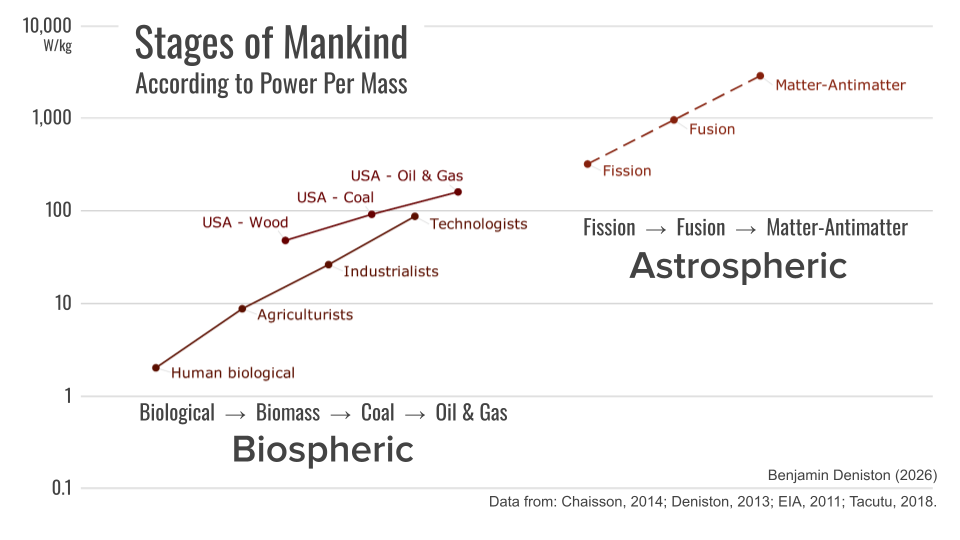
As fossil fuels are products of the biosphere over evolutionary time, fission and fusion fuels are the products of stellar processes over stellar and galactic time. As a fossil fuel-powered physical economy is the representation of mankind as an evolutionary biospheric force, a nuclear-powered physical economy will be the beginning of mankind as an astrospheric force, capable of bringing the solar system (and eventually other stellar systems) under his regime of negentropic development.
Thus, the coming transition of mankind from a biospheric evolutionary force into the very beginnings of an astrospheric force is the next leap in mankind’s natural process of encapsulating the negentropic systems that compose the universe, and expressing them in new and more powerful ways.
Graphic by Benjamin Deniston, using data from: Chaisson, 2014; Deniston, 2013; EIA, 2011; Tacutu, 2018.
We live in a universe composed of nested processes of creative development, characterized by systems of increasing complexity and potential (from galaxies, to the biosphere, to physical economy), and each system is defined by its characteristic negentropic agent (from stars, to living organisms, to mankind). But only mankind defines his existence by discovering and mastering successive new forms of file. This is the physical manifestation of mankind's unique ability to encompass the systems composing the universe, and the expression of a power we call human creativity.
Human creativity and science aren’t just about understanding facts about the natural world. Human creativity has a specific expression, the expansion of the sphere of mankind’s negentropic impact over increasingly larger domains, and more fundamental developmental systems that compose the universe itself. That is, mankind encapsulating, expressing, and representing the creative nature of the universe in increasingly more fundamental and powerful ways is the scientific expression and definition of mankind in the image of God.
Since the characteristic expression of human creativity, through physical economy, is the emulation of the creative processes that compose the universe, physical economic progress becomes a proof for the coherence between human creativity and the underlying nature of the universe as a whole. That is, we have no basis to believe the propaganda masquerading as science claiming that mankind is some accidental and temporary formation of atoms which happens to be slightly smarter than other animals.
Mankind is a unique and special expression of the universe’s own creative nature, with a responsibility to carry forward the processes of creation that created our universe. Every human being has the inalienable right to participate in that process.
That’s what a healthy scientific perspective shows us, when not corrupted by oligarchical ideology. It’s time to unleash human progress and productivity, creating a culture and scientific outlook that celebrates mankind and human creativity.
Chaisson, 2014 – “The Natural Science Underlying Big History,” Chaisson, Eric, The Scientific World Journal, Volume 2014, doi: 10.1155/2014/384912.
Deniston, 2013 -- “Biospheric Energy-Flux Density,” Deniston, Benjamin, 21st Century Science and Technology, Spring 2013.
Deniston, 2020 -- “Part 4: USA—Successes, Failures, & Potential,” Deniston, Benjamin, Energy Flux Density Series, LaRouchePAC, October 29, 2020.
Eisenhower, 1961 -- Farewell Address by President Dwight D. Eisenhower, January 17, 1961. https://www.archives.gov/milestone-documents/president-dwight-d-eisenhowers-farewell-address
EIA, 2011 -- “Annual Energy Review 2011,” U.S. Energy Information Agency, September 27, 2012. Note, this does not include the use of animal power, or harvesting water or wind power for mechanical purposes.
Heintz, 2023 -- “Dilution of chemical enrichment in galaxies 600 Myr after the Big Bang,” Heintz, K.E., et al., Nature Astronomy, September 2023, 7, 1517-1524.
Hoehler, 2023 -- “The metabolic rate of the biosphere and its components,” Hoehler, T., et al., PNAS, Vol. 120, No. 25, June 12, 2023. https://doi.org/10.1073/pnas.2303764120.
Kleidon, 2012 -- “How does the Earth system generate and maintain thermodynamic disequilibrium and what does it imply for the future of the planet?” Kleidon, Axel, Phil. Trans. R. Soc. A. Math Phys Eng Sci., 370:1012–1040, March 13, 2012.
More, 1899 -- The Prometheus Bound of Aeschylus, Aeschylus, Paul Elmer More (Trans.), Boston, Houghton, Mifflin and Co., 1899.
Seaborg, 1962 -- Civilian Nuclear Power—A Report to the President, U.S. Atomic Energy Commission, Seaborg, Glenn T., Chairman, November 20, 1962
Tacutu, 2018 -- AnAge:The Animal Ageing and Longevity Database, http://genomics.senescence.info/species. Tacutu, R., Thornton, D., Johnson, E., Budovsky, A., Barardo, D., Craig, T., Diana, E., Lehmann, G., Toren, D., Wang, J., Fraifeld, V. E., de Magalhaes, J. P. (2018), "Human Ageing Genomic Resources: new and updated databases." Nucleic Acids Research 46(D1):D1083-D1090, January 2018.
President of Promethean Action. Living at the intersection of politics, science, and economics. Spent 6 years working with and then leading Lyndon LaRouche's scientific research team (the "Basement"). [email protected]
There's no resource crisis — only a technology crisis. The critical minerals challenge proves what counts as a "resource" is defined by our technology, not nature.
The U.S. is exposed on critical minerals — not just in the ground, but in how we process them. Ben Deniston on the higher-energy technologies that could close that gap for good.
The universe isn't a machine. Bruce Director makes the case that consciousness, creativity, and Plato are coming back to science — and why that matters for everything.
Trump lost the Supreme Court tariff ruling—and immediately hit back with new tariffs. But the real story is bigger: America's productive economy has been hollowed out, and tariffs are the way back.