President Trump, Xi Jinping and Vladimir Putin are meeting in Shenzhen, the first summit ever of the U.S., China, and Russia leaders. The press calls it Yalta 2.0; Susan Kokinda argues London really fears a Bretton Woods 2.0, and follows the gas-price trail back to 1971.
Barbara ties Senator Elissa Slotkin’s call to Trump-proof the government to SpaceX catching a Starship and the expected Trump–Xi–Putin meeting: the party that called itself the party of progress is now running on stopping it.
Marco Rubio lays out a vision for America's future as Trump moves to rebuild the nation's infrastructure, restore American industry, and build a winning coalition for 2028. From air traffic control to AI and energy, it's time for the great American rebuild.
Trump lost the Supreme Court tariff ruling—and immediately hit back with new tariffs. But the real story is bigger: America's productive economy has been hollowed out, and tariffs are the way back.
The Supreme Court ruled 6–3 that Trump overstepped with IEEPA tariffs. Within hours, the administration fired back—reimposing tariffs through Section 122 of the Trade Act of 1974, and Trade Rep Jameson Greer made it clear: the 35–50% tariffs on Chinese goods aren't going anywhere.
But Ben Deniston cuts deeper than the legal chess match. The real fight is over the future of the American productive economy. Historical data tells a stark story: when tariffs ran 30–50% (1880–1920), productive sectors made up over half of GDP and nearly half of non-farm labor. After NAFTA and the WTO gutted that framework, those numbers collapsed to roughly a quarter of GDP and a fifth of the labor force. Ben Deniston applies a LaRouche-inspired "physical economics" lens — measuring real productive labor and energy throughput, not Wall Street's GDP fiction. The conclusion? Tariffs aren't just trade policy. They're the front line of reversing America's entropic collapse through reindustrialization and energy expansion.
00:00 Court Blocks Tariffs 00:27 Why Tariffs Matter 01:42 Supreme Court Response 02:50 McKinley on Cheapness 03:31 Measuring Productive Economy 04:10 American System Golden Age 04:47 Postwar Cracks Appear 05:19 Deindustrialization Begins 06:09 NAFTA and WTO Collapse 06:48 Physical Economics Framework 07:22 Hamilton and LaRouche 08:33 Free Energy vs GDP 09:53 American System Philosophy 10:59 Rebuild and Call to Action
SUPPORT PROMETHEAN SCIENCE!
Keep our scientific deep-dives 100% independent by becoming a paid subscriber for just $10 a month.
Your subscription supports every analysis revealing mankind as a unique creative force to be celebrated—no academic "trust the science" propaganda.
If you value scientific truth that challenges the status quo and want to help us keep illuminating mankind's creative potential in the universe, hit that subscribe button now and join us in championing human progress.
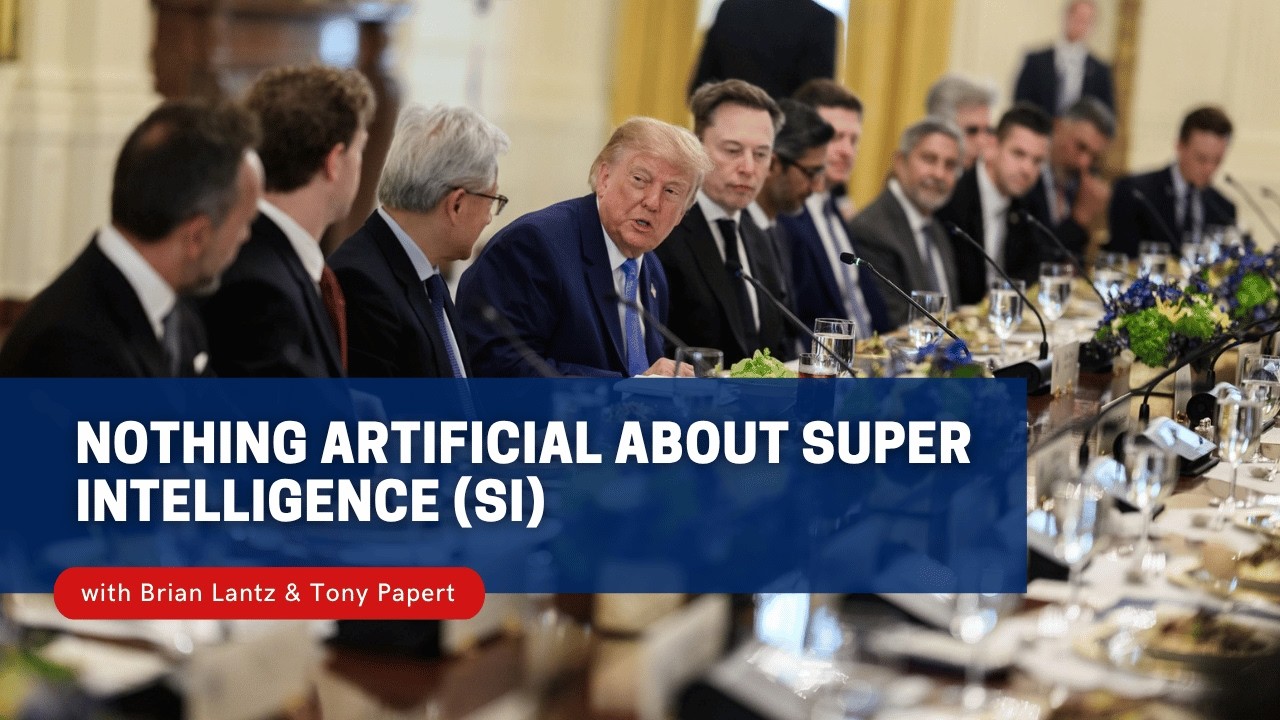
Why “super” and not “artificial”? Brian Lantz shows SI at work in an Arizona copper mine, aimed at a nuclear-powered Moon, and in service of new forms of human creativity. Watch the full class.
Bruce Director digs into your comments from the Aug 29 class: why the British System is inherently entropic, why no equation can predict a creative discovery, and how frontier science backs the American System’s idea of man.
Cable news is arguing eggs, beef, gas, and Iran. Bruce Director spent Saturday night on the real midterm question: American System vs. British System — two flavors of the same entropy, and nine weeks to pick a future.
Chatbots dominate the AI argument. Brian Lantz spent Saturday night on the other kind — robots, machine shops, and factory floors — and why manufacturing, not the data center, is where the country actually gets richer.