A new Washington Post report raises questions ahead of the 2026 midterms. Mike Steger examines the officials, political networks, and election preparations behind the headlines.
After a week of pressure from President Trump, Zelensky said "yes" to a freeze on Fox. The same week, Data Republican released files that Barbara says lay out the Democrats' midterm chaos plan. With 11 days to go, here's the story and what you do about it.
Today's LIVE show is over. Catch the REPLAY and join us live next Thursday. Zelensky just said "freeze" the war. At home, leaked tapes game out a midterm "meltdown."
From Leibniz's Vision to Trump's Toast: A Coherent Arc of Cross-Civilizational Development
From Leibniz to Trump's Beijing toast, a 300-year tradition connects American founders to China through mutual development—not rivalry. Discover the forgotten philosophy behind true sovereignty and national greatness.
President Donald J. Trump participates in a welcome ceremony with President Xi Jinping of the People’s Republic of China, Thursday, May 14, 2026, at the Great Hall of the People in Beijing, China. (Official White House Photo by Daniel Torok)
President Trump's 2026 state banquet toast in Beijing echoes a philosophical tradition stretching back more than three centuries—a tradition that treats the exchange of knowledge and productive capacity between great civilizations as the true foundation of wealth and sovereignty.
When President Trump invoked Samuel Shaw's 1784 arrival in China, Benjamin Franklin's publication of Confucian maxims, and the Chinese stone tablet honoring George Washington at the Washington Monument, he was not merely offering diplomatic pleasantries. He was articulating a vision of the U.S.-China relationship grounded in mutual respect and shared advancement rather than zero-sum rivalry.
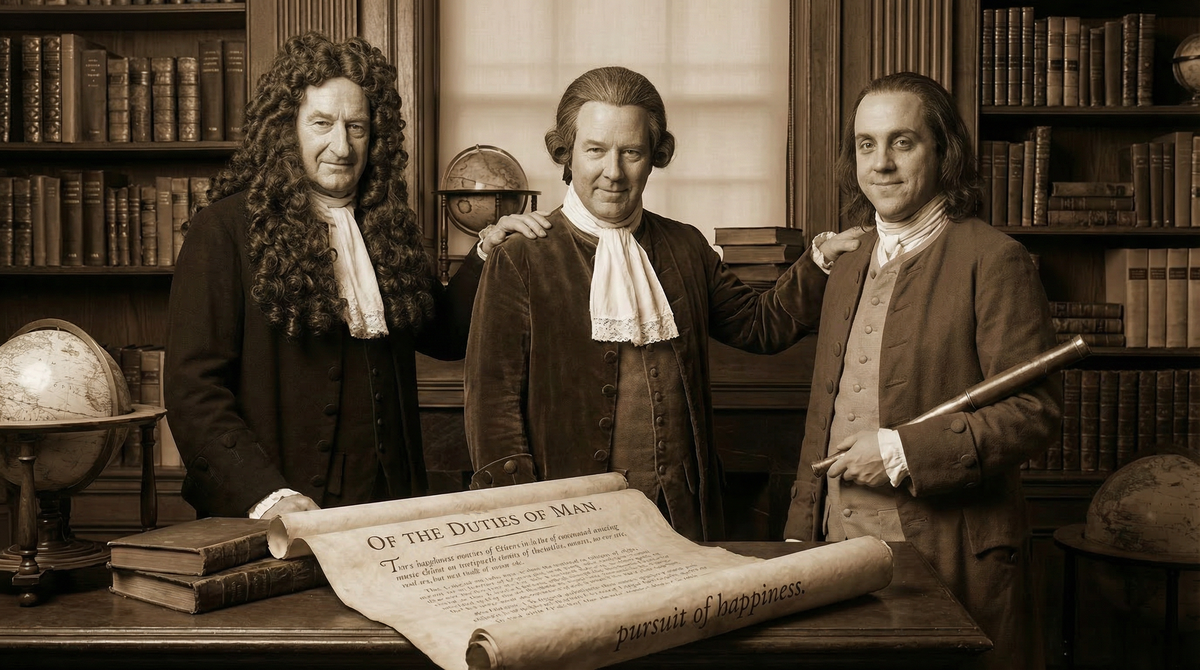
The role of Gottfried Leibniz and his influence on our founding fathers has almost been obliterated from the history of America.
Leibniz provided, through direct correspondence and his writings, the conceptual, scientific and cultural foundations that informed the anti-oligarchical development of individuals like the Winthrops, the Mathers, James Logan and Ben Franklin, among others.
Here, we examine the little-known vision of Leibniz of collaboration between China, Russia, Europe and by extension, the Americas, as the basis for world peace and development.
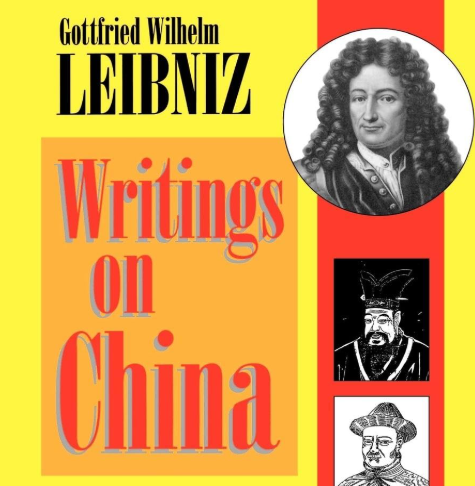
Gottfried Leibniz Writings on China Paperback
Leibniz (1645 -1716) had a lifelong interest in things Chinese and accorded China an important role in his ecumenical endeavors. This collection of his writings presents his comparisons of Chinese and European civilizations and his thoughts on future relations between the two.
In the late seventeenth century, Leibniz was organizing a systematic intellectual exchange between Europe and China, mediated by Russia. This project was reflected by Franklin in the founding era of the American republic. Leibniz’s discoveries were revisited in Lyndon LaRouche’s conception of "physical economy" and great-power cooperation.
Leibniz and the Jesuit Mediation of China
The opening of China to the West was initiated by the Jesuits. The early Jesuit missionaries became the trusted advisors to the Emperor, who initiated a mutual exchange of knowledge in the fields of astronomy, science, mathematics and philosophy between the East and the West. This included both the examination of Christianity by the Chinese Emperor and his scholars, and an in-depth study of Confucianism by the Jesuits.
Leibniz had initiated his own comprehensive study of these matters and was in direct correspondence with some of missionaries in China. Philippe Couplet, one of the Jesuit missionaries introduced Shen Fu-Tsung to Europe. He was the first Chinese intellectual and Christian convert from China to ever visit Europe.
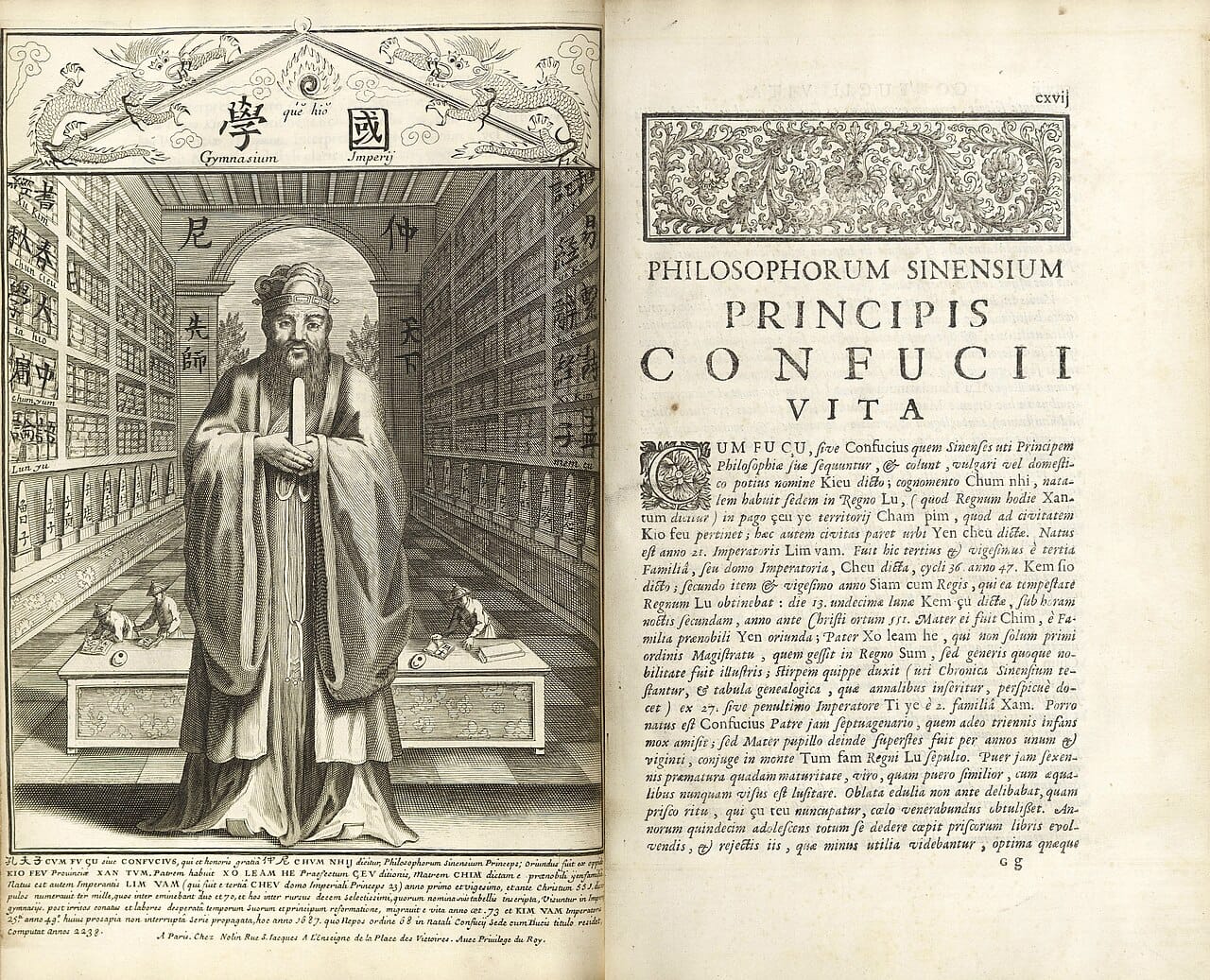
While Leibniz was not in direct communication with Couplet, he studied intensely Couplet's 1687 Confucius Sinarum Philosophus—a Latin rendering of core Confucian texts compiled by Couplet, Prospero Intorcetta, and their colleagues. In that work, they made Chinese moral philosophy accessible to the European Republic of Letters.
Confucius, Philosopher of the Chinese, or, Chinese Knowledge Explained in Latin (1687), produced by a team of Jesuits led by Philippe Couplet (public domain).
Leibniz came to view Confucianism as a rational, this-worldly ethics compatible with natural theology and universal principles of morality, sociability, and ordered government.
In his 1697 Novissima Sinica (News from China), Leibniz gave this exchange of knowledge its most explicit formulation in a letter to Russia’s Peter the Great, who he was advising.
Leibniz viewed Europe and China as the two "extremes" of a single field of cultivated humanity, differentiated not by hierarchy but by complementary excellences: Europe perhaps more advanced in theoretical sciences and mechanics. China, through Confucianism, as more advanced in practical ethics, social order, and certain useful arts.
Providence, he suggested, may have arranged affairs so that these distant peoples "stretch out their arms to each other," creating a circuit through which intermediate regions are uplifted. He insisted that Russia was the mediating power here. Russia could link Europe to China and become a conduit for scientific exchange and infrastructural development across Eurasia, turning mere contiguity into a deliberate pathway of discovery and improvement.
Leibniz, Logan and Franklin
James Logan purchased Couplet’s 1687 Latin Confucius Sinarum Philosophus in 1733 for his personal library and it was included in the Loganian Library catalogue, which Ben Franklin set up upon the death of James Logan.
While there is no direct evidence that Logan and his protege, Ben Franklin, discussed this book directly, here is what we do know.
Benjamin Franklin extended Leibniz's logic across the Atlantic, treating China as both a benchmark and a reservoir of transferable techniques, products, and civic virtues.
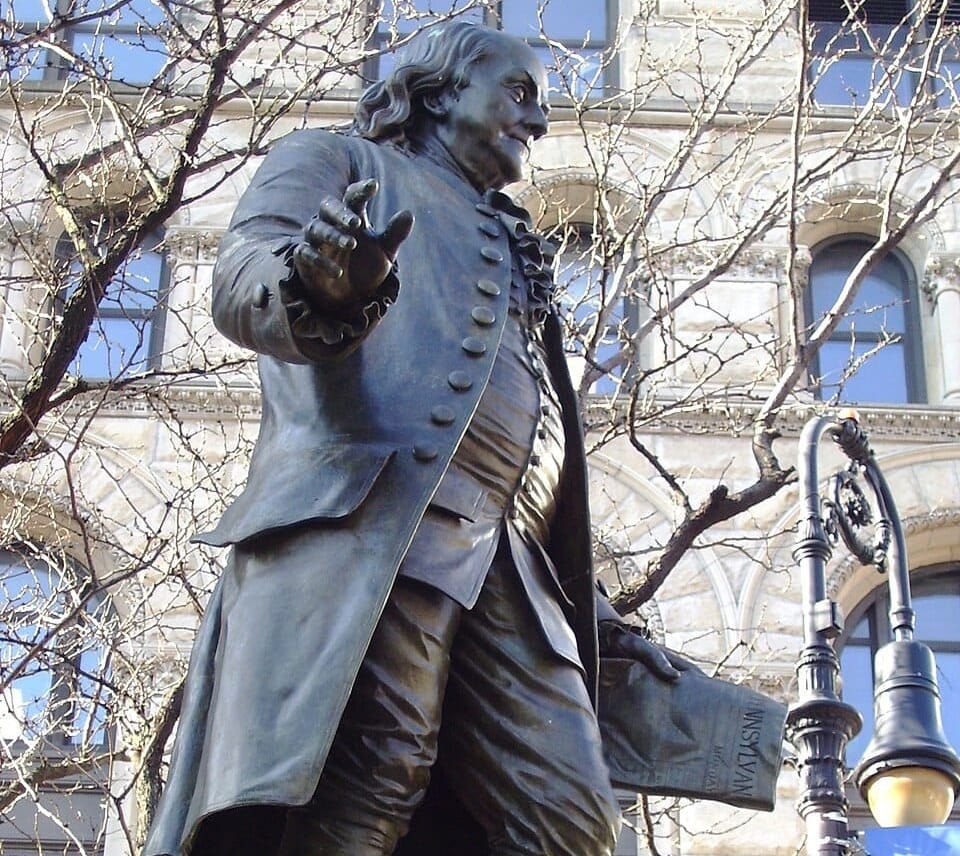
A statue of Benjamin Franklin in the Financial District of Manhattan, New York City. Credit: Beyond My Ken (CC BY-SA 4.0).
In 1737, Franklin published selections from Confucian moral philosophy in the Pennsylvania Gazette, introducing his readers to maxims of diligence, frugality, and public-spiritedness. He mined Chinese material culture for practical innovations—porcelain, silk, ginseng, heating technologies such as improved stoves, and shipbuilding techniques like watertight bulkheads—that could be consciously transplanted to build a new kind of republic in North America.
Franklin used China as an empirical and rhetorical model: a populous, industrious society with high living standards and stable social virtues. He argued that North America could equal or surpass China in population and prosperity if it embraced similar habits of industry, thrift, and rational improvement—exactly the sort of cross-civilizational borrowing that Leibniz's Novissima Sinica had framed in principle.
LaRouche and the Modern Physical Economy
Lyndon LaRouche's conception of "physical economy" explicitly claims Leibniz as the founder of modern economic science.
LaRouche elaborated two related Leibnizian themes: first, that "economy" concerns the discovery and application of universal physical principles—dynamics, technology, rational organization of labor—rather than the circulation of money as such. Second, that the wealth of a society lies in its increasing power to transform nature, measured as rising productive powers of labor per capita and per square kilometer, not in speculative gains or monetary accumulation.
LaRouche’s proposed "Four Power" alliance of the United States, Russia, China, and India mirrors Leibniz's tri-continental schema but shifts the focus to contemporary great powers capable of anchoring a new credit and development system. Russia retains its mediating position; China is indispensable because of its formidable industrial base and historical role in scientific creativity; India adds another civilizational center and demographic weight; and the United States, in LaRouche's view, must revive its Hamiltonian-Franklinian tradition to play a constructive rather than imperial role.
Cooperation among these powers, LaRouche argued, would channel credit into scientific and infrastructural projects—energy, transport, industry—that raise global productivity, a modern restatement of Leibniz's idea that cross-civilizational exchange in the sciences and useful arts is the real engine of prosperity and moral improvement.
The Coherent Arc
When President Trump referenced the 1784 arrival of Samuel Shaw aboard the first American trading ship to reach China, he was invoking the historical continuity of a relationship that predates the U.S. Constitution itself.
His mention of Franklin's publication of Confucius and the Chinese stone tablet at the Washington Monument, served to position the current U.S.-China relationship within a longer narrative of mutual respect and cultural exchange.
This narrative aligns precisely with the tradition that runs from Couplet and Leibniz through Logan and Franklin to LaRouche: the claim that genuine wealth and durable sovereignty arise not from hoarding money, controlling sea lanes, or dominating colonies, but from organizing the exchange and advancement of universal principles—scientific, technical, and moral—among distinct civilizations.
The Jesuit China mission, Leibniz's Novissima Sinica, Franklin's Chinese enthusiasms, LaRouche's Four Power schema, and Trump's Beijing toast are all, despite their differences, variations on this theme: that the highest form of statecraft is to align national development with an ever-expanding, cross-civilizational project of discovery and improvement.
Activist with LaRouche since the 1970s. Author and speaker on the culture of the American Revolution, Ben Franklin, and James Logan. Follow my Substack, “Creating a New American Intelligentsia.”
A new Washington Post report raises questions ahead of the 2026 midterms. Mike Steger examines the officials, political networks, and election preparations behind the headlines.
After a week of pressure from President Trump, Zelensky said "yes" to a freeze on Fox. The same week, Data Republican released files that Barbara says lay out the Democrats' midterm chaos plan. With 11 days to go, here's the story and what you do about it.
Today's LIVE show is over. Catch the REPLAY and join us live next Thursday. Zelensky just said "freeze" the war. At home, leaked tapes game out a midterm "meltdown."
Leaked files from Data Republican expose a plan to turn midterm unrest against Trump, as the Washington Post reports officials advising 10 states. Barbara Boyd on the 2020 rerun and making November 3 too big to rig.




.jpg?ref=prometheanaction.com)