Barbara on Trump’s UN day: nation-state vision vs Lula’s globalism, Shield of America vs narco-terror, and peace moves on Ukraine and Iran while Europe talks war. Media obsesses over desk bans; he closes on AI as industrial renaissance, not apocalypse.
Trump strips White House access from select outlets; Democrats cry dictatorship, but the real target is the propaganda machine Bertrand Russell blueprinted in 1953. $6 diesel traces to decades of green, zero-growth policy—not Iran.
Mike Steger explores Trump’s vision for the Americas, Brazil’s election, and how energy abundance and industrial growth could make the Western Hemisphere richer than Europe.
Saturday Class - Canada: Time to Reclaim our Lost 14th State - August 8, 2026
In 1775, Americans and Quebec militiamen fought as brothers to free Canada from the British crown. Bob Ingraham on the lie of the "invasion," Franklin's near-miss at the peace table — and why, 250 years later, the question is open again.
Almost every account you’ll find — the textbooks, Wikipedia, all of it — records that in 1775, America “invaded” Canada.
In this week’s Saturday Class, Bob Ingraham takes that story apart. And he starts with a more uncomfortable question: what exactly is the “nation of Canada” today?
A kingdom wearing a maple leaf
Canada is not a republic. It is not a democracy. It is a monarchy — its head of state is King Charles III, who holds a separate crown as King of Canada under the Statute of Westminster of 1931.
The King’s personal representative, the Governor General, appoints Canada’s Supreme Court justices, its lieutenant governors, and its senators — who, like the House of Lords, are not elected by anyone. The Governor General can summon and dissolve parliament, call elections, acts as commander in chief — and can remove a sitting prime minister, as the crown’s representative in Australia actually did in 1975.
Above it all sits the King’s Privy Council: advisors appointed for life, with the power to overturn acts of Parliament, each bound by a personal oath:
I do solemnly and sincerely swear that I shall be a true and faithful servant to His Majesty King Charles… In all things I shall do as a faithful and true servant ought to do for His Majesty the King.
— Oath of the King’s Privy Council for Canada
And who is the Governor General today? Louise Arbour — installed this past June. Bob ran her résumé: the Hague prosecutor of Slobodan Milošević, later UN High Commissioner for Human Rights, head of the George Soros–funded International Crisis Group, and the UN’s special representative for migration, where she argued that Western nations have a moral duty to accept open borders and unlimited immigration.
Below her stands Prime Minister Mark Carney — Harvard, Oxford, Goldman Sachs, the Bank for International Settlements, a fixture at Davos, and the only man ever to run both the Bank of Canada and the Bank of England. A central banker par excellence, groomed for the role over decades — and legally subservient to the King, the Governor General, and the Privy Council.
The people of Canada live under a royal tyranny — under a government whose allegiance is not to the people of Canada, but to the oligarchical system it represents.
— Bob Ingraham
Fifteen colonies, one revolution
In 1775 there was no legal entity called Canada. Continental North America held fifteen British colonies: the thirteen we know — plus Quebec, and Nova Scotia, governed from Halifax.
As British rule tightened, correspondence flowed constantly between Philadelphia and the north. Patriots in Quebec pleaded for aid from the Continental Congress: we cannot resist Britain on our own.
On October 26, 1774 — almost two years before the Declaration of Independence — the First Continental Congress formally addressed the inhabitants of the Province of Quebec:
Your province is the only link wanting to complete the bright and strong chain of union.
— First Continental Congress, Address to the Inhabitants of the Province of Quebec, October 26, 1774
The Articles of Confederation later made the offer permanent: Canada would be admitted into the union, entitled to all of its advantages, at any time it requested.
A group calling itself the Sons of New England put it plainly in its own appeal: “You should, in all respects, be as perfectly free as ourselves… we trust you will, with us, resolve to exert all your powers and risk everything for the defense of American liberty.”
And in September 1775, George Washington issued an open letter — in his own hand — to his “friends and brethren” in Canada:
Come then, my brethren, unite with us in an indissoluble union. Let us run together to the same goal… The cause of America and of liberty is the cause of every virtuous American citizen.
— George Washington, Address to the Inhabitants of Canada, September 1775
General Richard Montgomery, who would command the expedition north, put the mission in one line: “We come with a professed intention of eradicating tyranny.”
What did Quebec need liberating from? Britain took the colony from France in 1763 — and spent the next twelve years deliberately constructing a structure of imperial rule:
A corrupt bargain with the church hierarchy. The Catholic leadership got near-total control over domestic life, education included, in exchange for absolute loyalty to the throne. After 1763, the Bishop of Quebec’s salary was paid directly from London.
A feudal land system. Of Quebec’s roughly 100,000 residents, more than 90% were tenant farmers — the habitants — working the estates of a tiny landed aristocracy, the seigneurs. Britain kept the old French system and strengthened it.
The Quebec Act of 1774. Parliament annexed to Quebec all land north of the Ohio River — today’s Ohio, Michigan, Indiana, Illinois, Wisconsin, and beyond — walling the thirteen colonies in from the north and west, with Quebec as the staging ground.
I see no reason why the loyal inhabitants of Canada should not cooperate with the rest of the empire in subduing the upstart colonists to the south.
— a British lord, 1775, as quoted by Bob in the class
Not an invasion — a combined operation
In late June 1775, at Washington’s urging, the Continental Congress voted to send troops north. Two prongs: Montgomery up Lake Champlain toward Montreal with 1,400 men, and Benedict Arnold with 1,100 more — by boat to Maine, then overland through 400 miles of wilderness toward Quebec City.
General Philip Schuyler, the operation’s original commander, had insisted a minimum of 6,000 troops was required. They got 2,500 — and at no point in the entire campaign did the American force match the British in men or guns.
The cost came fast. Winter hit early and hard. Smallpox swept both armies. A quarter of Arnold’s force turned back, and by the time he reached the St. Lawrence he had 650 men left — exhausted, sick, near starvation.
What saved them was the people of Canada. Towns took the soldiers into their homes, fed them, and nursed them back to health. At St. Francis parish, the locals rang the church bell and declared the army had been sent from heaven to restore their liberty.
Montgomery’s column, welcomed town to town, took Fort Chambly, then Fort St. Jean — 700 British troops surrendered — and when Montreal was left indefensible, Royal Governor Guy Carleton fled downriver. Montgomery entered the city unopposed. One town along the way was taken by a force that was half Continental soldiers, half local Quebec militia — fifty-fifty, fighting side by side.
Carleton’s counterattack failed spectacularly. His recruiters, sent to raise pro-British militias, were expelled from town after town — in one case stoned by the women of the town and driven out. By June 1775 he had put the entire province under martial law. One town’s written manifesto on the Americans’ arrival: “our chains are broken.”
Canadian partisans burned bridges and boats, seized British supplies, and turned captured horses over to the American armies — as Bob put it, they acted like the French resistance of 1943 and ’44.
What contributed most to the loss of the country is the treachery and villainy of the Canadians themselves.
— a British colonel, writing to London, November 1775
Now or never at Quebec City
Arnold reached the walls of Quebec City on November 13 and demanded its surrender. The fortified city refused. Montgomery joined him on December 2. Of the 2,500 men who had set out, about 1,100 remained — camped in the open before the city, exposed to a blizzard, with almost no artillery.
Why attack a walled city in those conditions? Because the St. Lawrence freezes. Everyone on both sides knew that when the ice melted, British warships would sail upriver and relieve the city. It was now or never.
The very first British artillery blast killed Montgomery and his senior officers, and his column was pulled out of the battle in a panic. Arnold’s men fought their way into the city street by street; Arnold was carried off severely wounded; Daniel Morgan pressed on to the rendezvous point — and waited for a column that never came. Surrounded, his force surrendered.
What happened next is the part the textbooks skip. Arnold rallied roughly 800 men and maintained the siege through the dead of winter — a force that was half American troops and half volunteer Quebec militia, who harassed the garrison, fired on its sentries, and burned British ships.
In May the ice melted and the trap closed: five British warships and 3,000 troops, then a second flotilla carrying 4,000 Hessians and General John Burgoyne. Eight to ten thousand men against 800. The long retreat ended at the New York border on July 1, 1776.
At exactly the moment the cause looked lost, recruitment to the pro-American Quebec militia went up, not down — young men joined the fight as the British advanced. And when the army crossed into New York, many of those Canadian militiamen marched out with it and became American citizens.
The Battle of Quebec — not the “invasion” of Quebec — cost 500 American soldiers killed and 2,000 more wounded or captured, alongside an uncounted number of Quebec militiamen who fell beside them. The intention, from the very beginning, was that Quebec would join the union as a free state.
Franklin almost took it back
The story has a coda. After Yorktown, Britain was desperate to end the war — its only significant army in America had just surrendered, and it was fighting France in a global war it was not sure of winning. At the peace table in Paris, Benjamin Franklin presented a list of non-negotiable demands. The British agreed to every one of them, almost immediately. Except one.
Franklin demanded that Britain turn over all of Canada to the United States. And the British did not say no. They hesitated — we are considering it, we need to discuss it. Franklin, by his own letters, was certain their desperation would deliver it.
Two things stopped him. His fellow negotiators, John Jay and John Adams, were satisfied with the deal on the table and told him to forget Canada — and British spies knew he wasn’t being backed. And France was flatly opposed: a British garrison in Canada would keep the new republic dependent on French protection. Franklin stood alone, and the moment passed.
The unfinished business of 1776
Two hundred and fifty years after the Declaration, our brothers and sisters in Canada still live under the crown. And as Bob laid out, under Carney that crown is playing an active strategic role: organizing an international coalition against President Trump and his policies on almost every front.
Bob offered no roadmap for how reunion happens — that, he said, is up to Canadians. But he pointed at the calendar: October 19, when Alberta votes in its referendum. It is not an independence referendum; a yes vote makes nothing law. But:
If it passes with a yes vote, it will certainly be a shot heard around the world… and how long the British can maintain their tight control over the rest of the Canadian provinces becomes very questionable.
— Bob Ingraham
We in America should do everything we can, as brethren, to help the people of Canada realize their freedom.
Watch the full class — then send it to the Canadian in your life who is ready to hear it.
—Promethean Action Editorial Staff
PS: The 2026 midterms will determine whether President Trump’s agenda survives and accelerates — or gets reversed and crushed.
Our Midterm Bootcamp is a semi-monthly training series equipping activists, candidates, and grassroots leaders with the ideas and messaging to win. Sign up and check your email for the next session’s Zoom link.
Author, historian, political organizer. Published books on American history, Dante, the global drug trade, the Anglo-Dutch Empire and National Banking. Former Editor at Executive Intelligence Review.
Founding member of the LaRouche movement in the 1960s. Former editor of LaRouche’s writings and EIR magazine. Regular host of our Saturday class series.
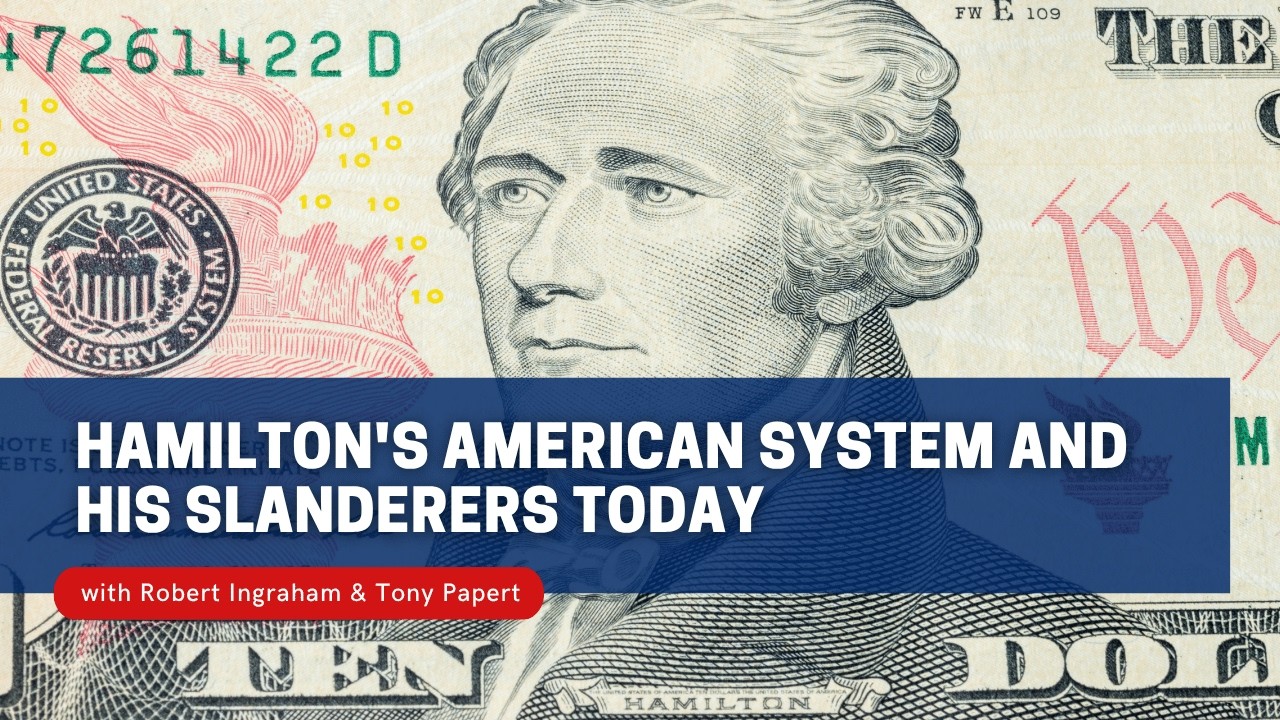
Bob takes on the slanders against Alexander Hamilton and the British-finance axioms most Americans still carry — and why Hamilton's bank is not the Fed.
Bruce Director digs into your comments from the Aug 29 class: why the British System is inherently entropic, why no equation can predict a creative discovery, and how frontier science backs the American System’s idea of man.
Cable news is arguing eggs, beef, gas, and Iran. Bruce Director spent Saturday night on the real midterm question: American System vs. British System — two flavors of the same entropy, and nine weeks to pick a future.
Chatbots dominate the AI argument. Brian Lantz spent Saturday night on the other kind — robots, machine shops, and factory floors — and why manufacturing, not the data center, is where the country actually gets richer.