While Europe plans 100,000 VW layoffs and Canada bleeds factories, Audi plants $4.2B in Georgia. London’s Chatham House playbook to go around your vote is on paper — and voters in Quebec, B.C., and Germany are already saying no.
Barbara on Obama's Detroit rally for El-Sayed and Slotkin, the red-green alliance burning France, Data Republican's Insurrection Act files, and making the November 3 midterms too big to rig.
Saturday Class - Why No Equation Can Predict a Discovery - September 12, 2026
Bruce Director digs into your comments from the Aug 29 class: why the British System is inherently entropic, why no equation can predict a creative discovery, and how frontier science backs the American System’s idea of man.
Bruce Director answers your website questions from the August 29 class: two systems, two ideas of man, and why no equation can forecast a discovery.
Tony Papert opened by noting those comments were serious enough to deserve a serious response. Election season pushes everything toward bite-size snippets — but anyone who wants to lead toward physical, economic, and spiritual progress has to go deeper, the way Franklin and Paine did.
Two systems, two ideas of man
The American System succeeds because it reflects a fundamental scientific principle about the nature of the universe.
Henry Carey, Lincoln’s economics advisor, put the choice this way — in Bruce’s paraphrase:
💡
One system leads to progress and human development. The British system always leads to slavery, decay, and collapse.
That is an empirical observation, not a campaign slogan.
The British System fails because it rests on a false idea of man and a false idea of the physical world — like trying to defy gravity by jumping off a building. Tinkering with interest rates, money flows, and regulations never touches the axiomatic flaw.
Adam Smith stated that flaw in his Theory of Moral Sentiments:
To man is allotted a much humbler department. Nature has directed us to the greater part of these by original and immediate instincts. Hunger, thirst, the passions which unites the two sexes, the love of pleasure, and the dread of pain prompt us to apply those means for their own sakes, and without any consideration of their tendency to those beneficent ends which the great director of nature intended to produce by them.
— Adam Smith, quoted by Bruce
Man as an animal of instinct — Mandeville’s private vice as public good.
The American counter
Man is created in the image of God — the only species that discovers principles of nature.
Those discoveries change our own behavior — and nature itself.
The empirical proof: growth of human population and power over nature.
Wealth is the creative mind
Hamilton’s Report on Manufactures settles the economics:
To cherish and stimulate the activity of the human mind by multiplying the objects of enterprise is not among the least considerable of the expedients by which the wealth of a nation may be promoted.
— Alexander Hamilton, quoted by Bruce
Wealth isn’t money flows. It is the stimulation of the creative mind — new technologies, new resources, new forms of labor.
Why no equation can capture it
People are schooled to think science means predictive math. Gödel showed no mathematical system can be both complete and consistent.
The British System’s preferred math is statistical mechanics — gas molecules bouncing into equilibrium, Clausius’s entropy increasing until nothing can change.
Creativity introduces something that was not in the existing relationships. Electricity is the example:
Franklin’s and Volta’s experiments became a major economic power no one at the end of the eighteenth century could have forecast.
Even in retrospect, no equation maps the pre-electricity economy onto the post-electricity one.
Marxist central planning and the Newton–Laplace clockwork universe delete the same thing.
Bruce drew on Lyndon LaRouche’s framing: an economy’s input is creative ideas; its output is more advanced creative ideas — with physical technology, new social relations, and culture in between.
❗
Bruce’s standing disclaimer: he worked with LaRouche from 1973 until LaRouche’s death, but is not associated with Helga Zepp-LaRouche or her organizations, disagrees strongly with them on policy, and speaks only for himself.
Your question: what about entropy?
Website commenters asked what Bruce meant by entropy and anti-entropy.
Clausius coined entropy studying heat-powered machines — and economics drove that science: before heat engines, mankind ran on muscle, wind, and water. Boltzmann reduced heat to molecular collisions. Cream diffuses into coffee. Everything runs toward equilibrium.
Norbert Wiener — whom LaRouche battled directly — turned the second law into a worldview:
We are swimming upstream against a great torrent of disorganization…. May we have the courage to face the eventual doom of our civilization as we have the courage to face the certainty of our personal doom. The simple faith in progress is not a conviction belonging to strength, but one belonged to acquiescence and hence to weakness.
— Norbert Wiener, quoted by Bruce
Bruce’s verdict: Wiener gave a perverted but revealing confession of why the British System always collapses — it is inherently entropic.
Anti-entropy is not entropy run backwards
It is an entirely different process — creative discovery reorganizing ideas.
In economics you can measure its effects: population, potential relative population density, energy flux density.
You cannot produce it with Wiener’s mathematics.
New experimental science — Michael Levin at Tufts, Dennis Noble’s immune-system example of a body creatively answering pathogens it has never met — indicates anti-entropy characterizes life itself.
The universe as a whole develops toward higher organization — a conclusion, Bruce noted, consistent with a creative principle in the universe. A Creator.
Watch the full class — then send it to the friend who thinks “science” proves decline is inevitable.
Philosopher and expert in anti-entropic science (dynatropy), Cusa and Leibniz. 50 year collaborator of Lyndon LaRouche. Author of “Riemann for Anti-Dummies.” Classical double bass player.
Founding member of the LaRouche movement in the 1960s. Former editor of LaRouche’s writings and EIR magazine. Regular host of our Saturday class series.
Bob Ingraham shows how Hamilton turned Revolutionary War debt into public credit — and why Bessent's growth fight with the IMF is the same war over who decides America's economic destiny.
Four young organizers took the American System onto Michigan campuses. Hear what Gen Z said, what they found undercover, and the challenge they're putting to you.
America went from candles and the horse and buggy to telephones, cars and airplanes, in one lifetime. Bob Ingraham shows how tariffs and Hamiltonian credit did it, and why the same tools, back in play today, can do it again.
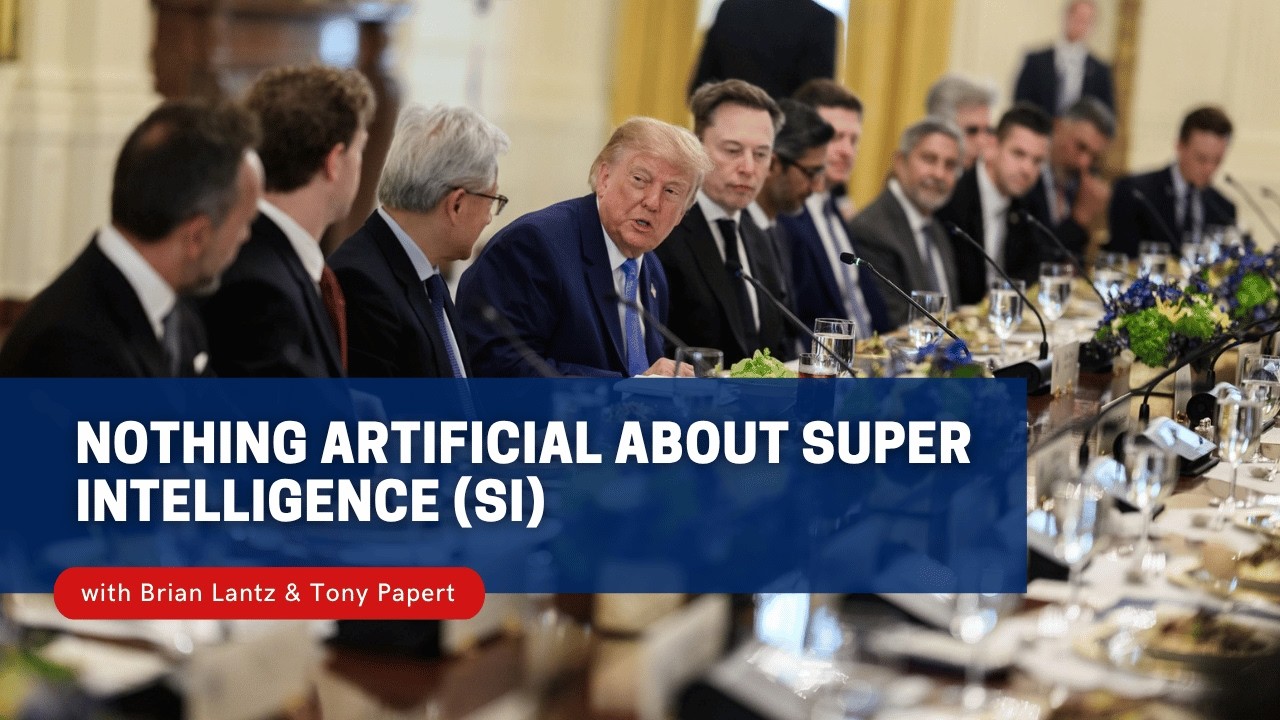
Why “super” and not “artificial”? Brian Lantz shows SI at work in an Arizona copper mine, aimed at a nuclear-powered Moon, and in service of new forms of human creativity. Watch the full class.