Iran isn't about Iran. Canada isn't about Canada. China isn't about tariffs. Every fight this week traced back to the same return address — and Trump has found it. Plus Zoomers, Bretton Woods, and Beethoven.
A full-size statue of Beethoven once stood behind the Boston Symphony. Toni Sellars and Mindy Pechenuk on how deep this music ran in 19th-century America — and who spent the next century getting it out.
Credit vs. Debt: Hamilton's Secret End Run Strategy
President Trump's tariffs and the Department of Government Efficiency's removal of destructive and wasteful spending are primarily defensive measures. Here we discuss the offensive measures required next to create the Golden Age of America.
In war and numerous games and sports, success requires both defensive and offensive strategies. At the moment, President Trump's tariffs and the Department of Government Efficiency's removal of destructive and wasteful spending are getting unprecedented international attention. They are primarily defensive measures; although, they do result in foreign companies, such as Hyundai, deciding to build new factories in the United States.
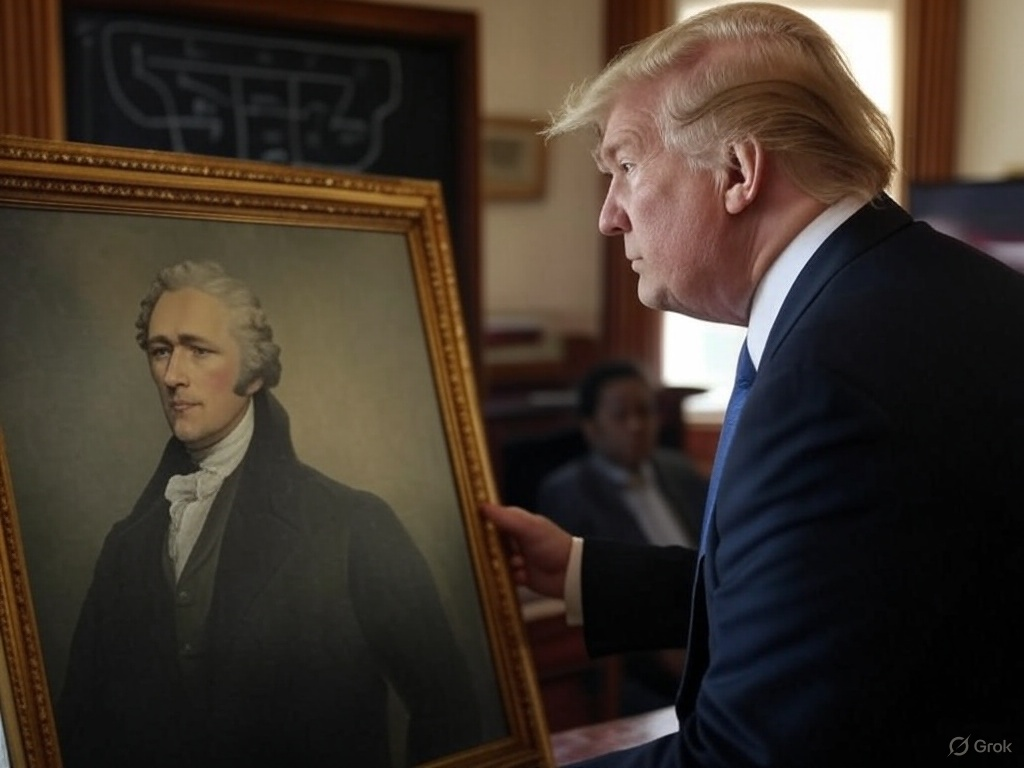
President Trump studying Alexander Hamilton. Image by Grok
Taking the Offensive
How do we enable American companies and individuals to step forward to both leapfrog current practices and build new productive plants and enterprises? In the current unprecedented environment, forecasting return on investment (ROI) or other financial results is impossible. So, we have to use every tool at our disposal to make it easy for individuals to take the leap of faith and start new productive projects.
Hamilton's Initiative
Faced with a bankrupt nation, our first Secretary of the Treasury, Alexander Hamilton, consolidated into the hands of the Treasury all of the unpaid debts of the 13 original states, converted that debt into long-term bonds, and set up a tariff program to pay off that debt. Our current Treasury Secretary Scott Bessent is attempting to follow that model in dealing with today's federal debt.
But, that was just the defensive part of Hamilton's program. The key to his success was the offense: creating a National Bank to provide new credit for the build-out of national infrastructure, mining, and manufacturing. He understood that the wealth of a nation could not be reduced to vaults of gold or silver.
"It is not the least expedient means by which the wealth of a nation may be promoted, to encourage the increase of the productions of its soil, and the extension of the objects of its industry." —Alexander Hamilton in the "Report on Manufactures" (1791)
"It is a fundamental maxim, in the system of public credit of the United States, that the creation of debt should always be accompanied with the means of extinguishment." —Hamilton in the "Report on a Plan for the Further Support of Public Credit" (1795)
He knew a secret: Every advance in technology, production, and productivity returns multiples of the initial investments made in them. So, while he was concerned to take hold of the national debt and put it into systematic "extinguishment," he was also happy to create new credit (by assuming more national debt in the sense of increasing the money supply) to be distributed through the National Bank to those enterprises and projects which would have the greatest effect upon rapidly expanding the productivity and real wealth of the nation. Properly distributed, the flood of output resulting from new National Credit can rapidly turn the old National Debt into a relatively tiny sum that can be easily paid down.
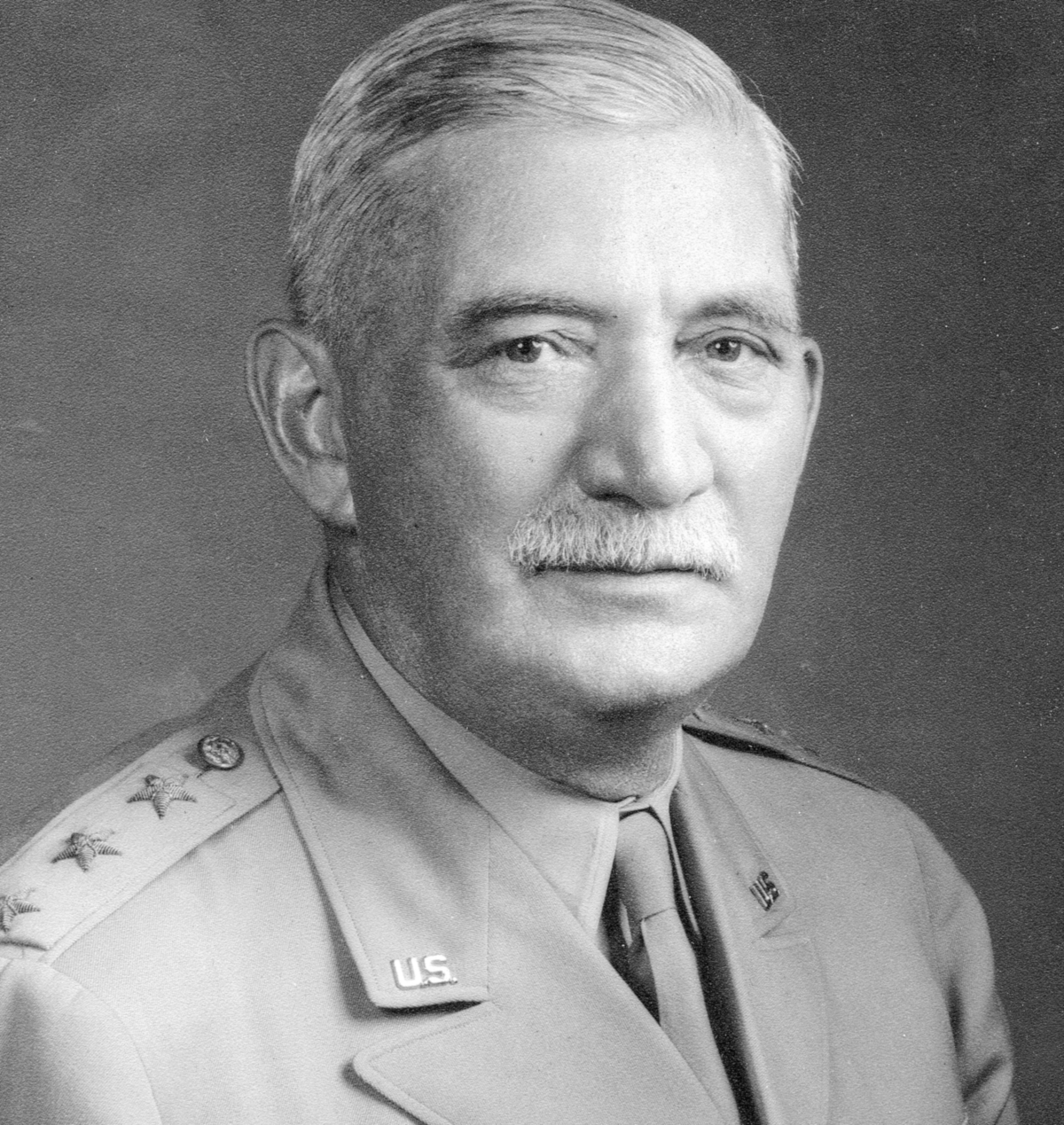
Production mastermind of Ford and GM, Bill Knudsen answered FDR's call to ensure that America's productive forces could be organized and expanded to supply the world. Photo by U.S. Army
We emphasize the words "properly distributed." Wall Street's Federal Reserve happily directs credit to almost every conceivable improper usage, to the exclusion of any proper usage. And even proper usage must be properly sequenced–as accomplished by Bill Knudsen for the World War II industrial mobilization.
A presentation by Susan Kokinda on the work of Bill Knudsen.
Trump's Next Move?
Since the days of Hamilton, we have experienced the wild successes of Lincoln's Greenbacks, and FDR's Reconstruction Finance Corporation. As Brian Lantz has pointed out, we have the new Sovereign Wealth Fund and several existing federal agencies which could effectively become institutions able to direct credit into promising endeavors and projects. President Trump and Secretary Bessent have also made clear that they intend to push more policies which will discourage speculation, mergers, and arbitrage. They will move to encourage practitioners of such predatory endeavors to reorient to the national good, and redirect their funds into actual investments in the new enterprises and projects which the nation needs and which President Trump is pushing.
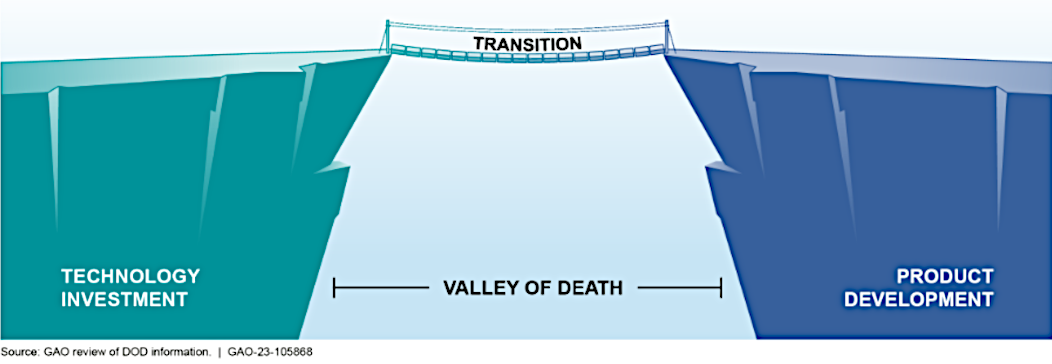
The "Valley of Death" between the idea and the successful production of products.
We have to make it easy for entrepreneurs and enterprises of national importance to get the equity or credit necessary to successfully cross the "Valley of Death" associated with going from an idea to successful and profitable production
Forget whatever you heard about the wonders of markets, monetarism, Adam Smith, or "Austrian School" economics. The American System of Hamilton, Lincoln, and LaRouche is the only one worth studying and implementing. It is the only one which will allow us to Make America Great Again.
Rebuild the USA: The Trump Presidency and Beyond
After all the years of campaigning, Americans have finally come to the agreement that we will Make America Great Again. But, how do we actually implement the intention, and with a minimum of mistakes along the way?
Modern science is built from the bottom up — math, then physics, then life, then mind. Every great discovery was made the other way. Bruce Director on how music exposes what your mind can do that no machine ever will — and why it's the key to a new revolution in science.
The chip in your phone, the guidance in your car — all of it came from the race to the Moon. Kesha Rogers on how Apollo ignited the digital age, and why Trump's Artemis Moon base is about to do it again.
Every leading astronomer in Europe tried to find the lost asteroid Ceres with statistics. Every one failed. An unknown 24-year-old, Carl Gauss, found it from 41 days of data — by refusing to calculate and insisting on principle. Bruce Director on why that method is the cure for the age of AI.