Treasury hit Bank of America with $1.2 billion in penalties for money laundering failures. Susan Kokinda traces the bank from Countrywide and the 1980s debt crisis to King Charles’ green finance club, and Bessent’s challenge to the IMF.
Trump's strategy goes far beyond Ukraine. Mike Steger examines how a sweeping geopolitical realignment could end a century of conflict in Europe and usher in a new era of Western civilization.
Four young organizers took the American System onto Michigan campuses. Hear what Gen Z said, what they found undercover, and the challenge they're putting to you.
Saturday Class - What is "Happiness" in our Declaration of Independence? - July 18, 2026
Everyone quotes "the pursuit of happiness." Almost nobody can define it. In the final class of her series, Judy Hodgkiss opens Leibniz's science of happiness — the philosophy Jefferson's generation absorbed and wrote into the Declaration.
Every American can quote “the pursuit of happiness.”
Almost no one can define it.
Jefferson’s generation could. In the final class of her three-part series, Judy Hodgkiss opens the books they learned it from.
In Part 1, Judy Hodgkiss traced the pursuit of happiness past the schoolbook story of John Locke to its real source: Gottfried Leibniz, carried into English politics by Lord Bolingbroke. In Part 2, she showed how Alexander Pope’s Essay on Man taught a generation of colonists — including a 20-year-old George Washington — to think like Leibniz before they ever heard his name.
This week, the destination: Leibniz’s philosophy itself, drawn from her new book. What did the man who defined wisdom as “the science of happiness” actually mean by the word Jefferson chose over property?
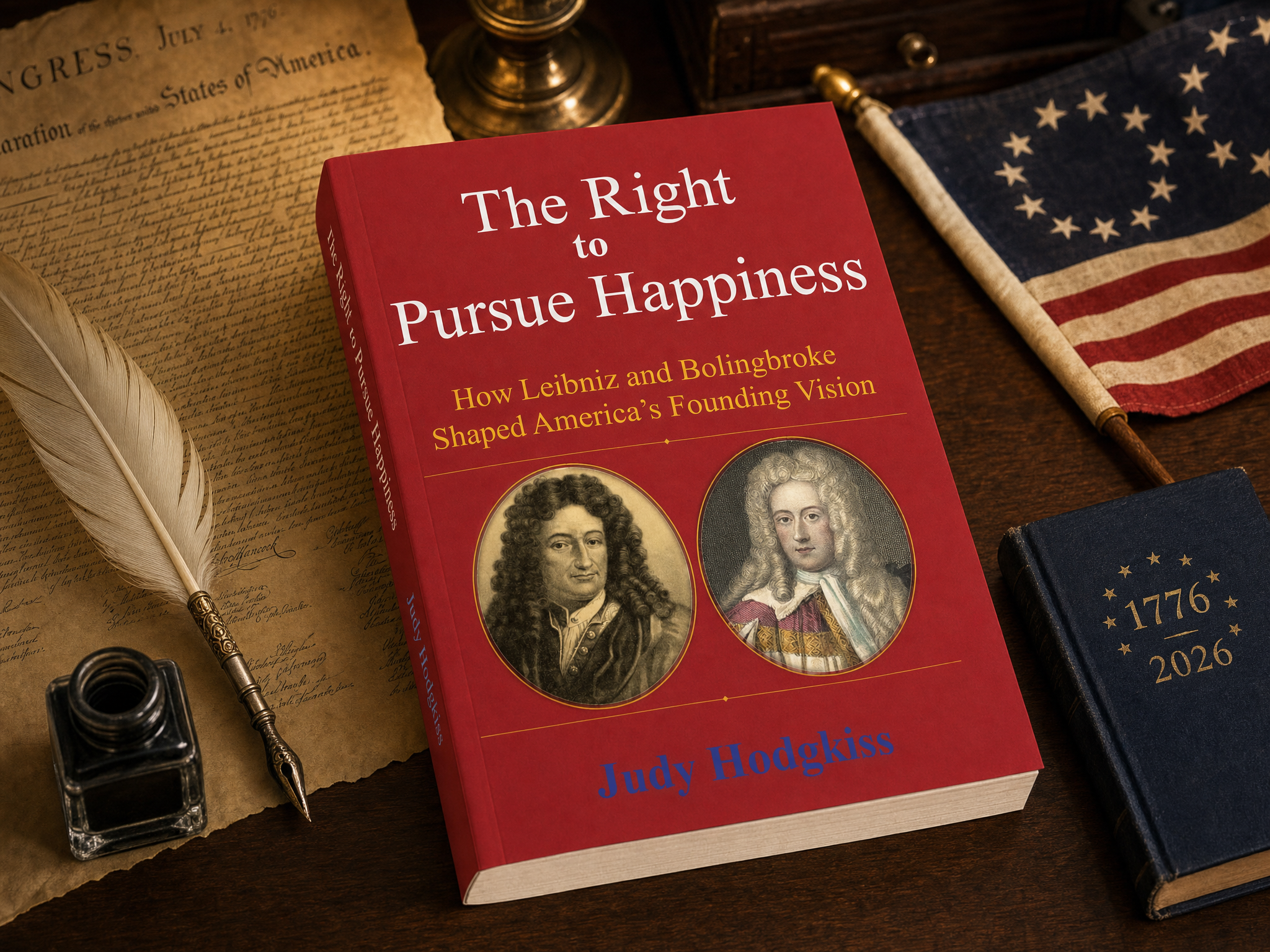
The Right to Pursue Happiness: How Leibniz and Bolingbroke Shaped America's Founding Vision
The 250th anniversary of the Declaration of Independence demands a serious reckoning with the nation's true history. Conventional historians have told you that the Declaration's immortal phrases—"endowed by their Creator with certain unalienable Rights...Life, Liberty and the pursuit of Happiness"—emerged from the cold calculations of a "social contract", as in a business agreement. This book shatters that materialist narrative.
Not a Hallmark one. Writing to his student Christian Wolff in 1715, Leibniz laid it out with a scientist’s precision:
“In morals, I set up our happiness as an end. This I define as a state of enduring joy… it is necessary that the joy be enduring, so that it not be withdrawn by a subsequent greater sadness.”
— Leibniz to Christian Wolff, 1715
Happiness is not a mood. It is a lasting state — which is why, Leibniz adds, “it is good to abandon or moderate some pleasures which can be harmful… by preventing better and more lasting pleasures.”
Then the definitions climb like a staircase: pleasure is the sensation of perfection. Perfection is the harmony of things — unity in variety. And the science that studies all of this — encompassing economics, politics, physics, even theology — is what Leibniz called wisdom itself.
This is the “happiness” of the Declaration: not a feeling to be indulged, but a condition of enduring joy that government is obligated — Leibniz’s word is must — to extend to the greatest degree possible.
The queen who almost was
How did a German philosopher’s ideas reach a disgraced English lord? Through one of the most remarkable family networks in history: the circle of the Electress Sophie of Hanover — Leibniz’s patron and lifelong correspondent.
When Queen Anne died in 1714, Sophie was heir to the English throne. She would have arrived with her privy counselor at her side: Leibniz, advising the Queen of England. She died two months too soon — and the world got George I instead.
But Sophie’s family carried the ideas anyway. Her niece’s son became Philippe II, Duke of Orléans — Regent of France for the child king Louis XV — and a man so steeped in Leibniz that his mother bragged about it to Sophie herself:
“My son has just come in. I immediately let him read Mr. Leibniz’s paper on unity. He even understands it, and says it is easy to understand — which I do not think at all.”
— The Duchess of Orléans to Sophie, 1706
Meanwhile Sophie’s great-niece, Anne Louise, Duchess of Maine, ran the most popular salon in France at her Château de Sceaux — hundreds of guests attending lectures on Leibnizian philosophy, demonstrations with telescopes and microscopes, and performances of Greek drama in which the Duchess herself sometimes took a role.
The exile who walked into Leibniz’s world
Into this network, in 1715, stumbled Henry St. John, Lord Bolingbroke — fleeing England with a treason charge at his back.
His nine years of exile became an immersion course. He frequented the Duchess of Maine’s salon — where he likely met his French wife. He grew close to the Regent. In 1719 he was begging a friend to lend him Leibniz’s side of the calculus debate, to compare against a letter of Newton’s already in his hands — almost certainly the original documents. And in 1722 he founded his own Paris society, the Club de l’Entresol, seeded with Leibnizians from the Paris Academy of Sciences.
“They have confirmed my taste for philosophy; they have revived that love which I had for belles lettres. How grateful I am to them.”
— Bolingbroke on the Club de l’Entresol, 1723
By the time he returned to England, he told Jonathan Swift: “I am no longer the bubble you knew me.” And to those who lumped him in with the fashionable “free thinkers” — the deists and skeptics he called “the pests of society” — he had a sharp answer: the study of nature doesn’t lead away from God, it leads toward Him. Persons of reason, he wrote Swift, “must needs be Christians on the best foundation — that which St. Paul himself established.”
The physics of happiness
Here the class takes its most surprising turn. Because Leibniz’s idea of happiness rests on his idea of force — worked out in his four years at Colbert’s Paris Academy of Sciences, alongside Denis Papin, the inventor whose “pressure cooker” experiments became the first piston-driven steam engine.
Newton defined force as mass times velocity — what Leibniz called a “dead” force. Leibniz insisted the real quantity, the living force (vis viva), was mass times velocity squared: the explosive power that drives a steam piston or an overshot water wheel.
In 1759, engineer John Smeaton stood before the British Royal Society and showed mill owners that if they built water wheels on Newton’s arithmetic, they would lose money — and if they built on Leibniz’s mv², they would profit. Newton’s own Royal Society, refuted by a water wheel.
Why does this matter for the Declaration? Because for Leibniz, force revealed the structure of creation: matter is infinitely divisible, but the power in things belongs to an indivisible governing substance — what he would later name the monad. From God, to the immortal human soul, to every level of nature below, creation is a nested hierarchy of substances, each with its own God-given capability of action.
His opponents — Father Malebranche’s “occasionalism,” Spinoza’s “one infinite substance” — dissolved all of that into a universe where only God acts and created things do nothing. Leibniz’s verdict: then “nature itself would be God” — and man would be reduced to a transitory phantasm. Bolingbroke despised Spinoza’s system on exactly the same grounds.
A human being with a real, active, immortal soul — born to develop, discover, and improve creation without end. That is the being who has an unalienable right to pursue happiness.
“If you are an American, this is your story”
From the pre-established harmony flows Leibniz’s most famous claim: God has created the best of all possible worlds — the world of maximum happiness and minimum evil. And from that flows the political conclusion Bolingbroke armed and the colonists toasted: government exists to promote the happiness of the governed.
Not the guarantee of happiness. The right to pursue it — in a universe where, as Leibniz wrote, “there are always parts asleep in the abyss of things yet to be roused… thus progress never comes to an end.”
Judy closes the series with an invitation: if you are an American, this is your story, your heritage. And if you’re not — but you’ve followed the ideas this far — consider yourself an honorary American.
Watch the class and learn what happiness meant to the man who made it a science.
Founding member of the LaRouche movement in the 1960s. Former editor of LaRouche’s writings and EIR magazine. Regular host of our Saturday class series.
Four young organizers took the American System onto Michigan campuses. Hear what Gen Z said, what they found undercover, and the challenge they're putting to you.
America went from candles and the horse and buggy to telephones, cars and airplanes, in one lifetime. Bob Ingraham shows how tariffs and Hamiltonian credit did it, and why the same tools, back in play today, can do it again.
Why “super” and not “artificial”? Brian Lantz shows SI at work in an Arizona copper mine, aimed at a nuclear-powered Moon, and in service of new forms of human creativity. Watch the full class.
Two conductors. One score. Two opposite ideas of man. This week's Class puts Furtwängler against Toscanini — and tonal against atonal. The fight over your ear is the fight for your children's future.